<?xml version="1.0" encoding="utf-8"?><feed xmlns="http://www.w3.org/2005/Atom" ><generator uri="https://jekyllrb.com/" version="4.4.1">Jekyll</generator><link href="https://ysood.xyz/feed.xml" rel="self" type="application/atom+xml" /><link href="https://ysood.xyz/" rel="alternate" type="text/html" /><updated>2026-09-03T15:57:03+05:30</updated><id>https://ysood.xyz/feed.xml</id><title type="html">ysood.xyz</title><subtitle>Yatharth Sood</subtitle><entry><title type="html">Phone Media Server</title><link href="https://ysood.xyz/articles/phone-media-server/" rel="alternate" type="text/html" title="Phone Media Server" /><published>2026-04-21T00:00:00+05:30</published><updated>2026-04-21T00:00:00+05:30</updated><id>https://ysood.xyz/articles/phone-media-server</id><content type="html" xml:base="https://ysood.xyz/articles/phone-media-server/"><![CDATA[<p>Self-hosting is cool! I think it especially blew up over the past couple of years, with the start of a wave of “cost recouping” for many streaming services, where they <a href="https://www.pcmag.com/news/ad-free-amazon-prime-video-more-expensive-lower-tier-drops-big-perk">introduced ads</a>, <a href="https://timesofindia.indiatimes.com/technology/tech-news/netflix-is-increasing-prices-again-across-plans-new-pricing-price-hike-timeline-and-all-other-details/articleshow/129837544.cms">increased subscription prices</a> across the board, and not to mention, just spawned too many of themselves that you ended up with a “subscription bundle” that cost way too much. But unfortunately for self-hosting, <a href="https://en.wikipedia.org/wiki/2024%E2%80%93present_global_memory_supply_shortage">something happened</a> last year that caused the RAM in my gaming PC to become an appreciating asset, and my “overpriced” SSD purchase from 2022 becoming a bargain find.</p>

<p>The consequences of the AI boom have been a disaster to my self-hosting plans. When I started to look around, I spent around 3 months dealing with the purchase of a cheap HP office PC from a seller on WhatsApp, which I shipped back (twice) because it just wouldn’t boot due to some BIOS issue that I simply couldn’t fix myself. In the end I spent more than the cost of the machine itself on the RAM (which it didn’t come with, of course) and the shipping (twice!). Burnt by that, I vowed to just buy a new mini PC when RAM and storage pricing makes sense again. And going by how things are, I will be waiting for some time.</p>

<p><img src="/media/articles/phone-media-server-1.png" alt="I don't exaggerate when I say that I audibly gasped when I saw this." />
<em>I don’t exaggerate when I say that I audibly gasped when I saw this.</em></p>

<p>Anyway, nothing was self-hosted thus. Enter <a href="https://www.gsmarena.com/xiaomi_redmi_note_10_pro_(india)-10771.php">Redmi Note 10 Pro</a>. A phone I used from 2021 to 2024, and never used without a custom ROM. It came from a time when the SD card slot was quite rare, but it had one. It was so charming to mess around and install a new Android versions’ custom ROM someone else had made, and that was a really great time. Eventually though, it was time to upgrade, and I got a <a href="https://www.gsmarena.com/samsung_galaxy_s23-12082.php">new phone</a> sometime in 2024. But as soon as I upgraded, the Redmi no longer had any use. I also didn’t want to sell it. I just kept it as the spare phone in your drawer that you keep for the day you need a spare phone.</p>

<p>As the need for a spare phone didn’t arise, the Redmi collected dust. I’d charge it to 100% and just track how long it would take to discharge with just a Wi-Fi connection (almost 10 days). On one or two occasions, I would use it as a webcam to capture my desk on a Discord call, but that was all it was used for. After 18 months of that, I suddenly remembered the app <a href="https://termux.dev/en/">Termux</a>, that would let you use a Linux terminal, over Android. And even without Termux, there was potential here. Thus, while I figure out all what I want to self-host, I could just get started with this phone, and work within its limitations. Whatever else I need after this can come later, of course. But something is better than absolutely nothing, right?</p>
<h2 id="why-do-this">Why do this?</h2>
<p><em>If you do know what self-hosting is, you already know why.</em></p>

<p>I let the utility of the phone server make itself known. As opposed to setting up the hardware and plopping things on it that everyone else suggests; I just waited for ideas to strike and for anything sufficiently inconvenient, I’d work something out with just this phone. With the limitations of an Android phone with an emulated Linux terminal (Docker is not a realistic option, for example), it was all going to be more primitive and simple. Any programs that were specifically made to work with Termux/repackaged for it were fair game, and thanks to the several contributors to the <a href="https://wiki.termux.com/wiki/Package_Management"><code class="language-plaintext highlighter-rouge">pkg</code></a> mirror of <code class="language-plaintext highlighter-rouge">apt</code> that Termux uses, I had many such options. I was not going to do anything taxing on the CPU/GPU for now, and that suits the platform I’m working with. No Immich, no Plex or Jellyfin, but that’s fine, and here’s what I got going over the last month of pondering and (some) vibe-coding:</p>

<ol>
  <li><strong>Torrent management</strong>. the <a href="https://aria2.github.io/"><code class="language-plaintext highlighter-rouge">aria2</code></a> utility lets you download things over several protocols, including BitTorrent. Combined with the JSON RPC and the <a href="https://github.com/mayswind/ariang">AriaNg</a> interface, you get a lightweight UI to control and manage your torrents.</li>
  <li><strong>Network-attached Storage</strong>. I am not made of Synology money. Or even “connect your 4TB WD MyPassport to your router” money, at this point. But having a place where you can just throw some files on that you can perhaps then download on your phone? Solid. Even better, I can stream a movie <em>directly</em> through <a href="https://github.com/9001/copyparty/"><code class="language-plaintext highlighter-rouge">copyparty</code></a>, truly one of the command-line utilities of all time <strong><em>(IT’S REALLY VERY GOOD).</em></strong> To say nothing of being able to play music or podcasts, all through copyparty. IT IS VERY GOOD, just watch <a href="https://www.youtube.com/watch?v=15_-hgsX2V0">this</a>. In fact, screw this article, just watch the video before and get using copyparty to set up whatever the hell you want!
    <ol>
      <li>One thing that I did have to spawn separately, but for the same use case, was <a href="https://github.com/azatoth/minidlna">miniDLNA</a>, a package that was already patched for Termux, that lets you broadcast your device and its files over the UPnP protocol. This was just to connect this server to my TV, and having it work “natively” instead of navigating to the copyparty page using the TV’s Web browser, and playing content from there. Also a godsend. I also figured out that it’s pretty feasible to rewrite the SSDP component of copyparty (which is meant for drive discovery over Windows PCs) to support DLNA too. I will contribute that to copyparty <a href="https://github.com/yatharthsood00/copyparty/tree/dlna">soon</a>, and add another feature to that Swiss Army Knife of a tool.</li>
    </ol>
  </li>
  <li><strong>Obsidian Vault</strong>. I don’t use Obsidian as much as more avid users, but having it synced across devices is a great thing to encourage my use of it. With the theme being self-hosting, I wasn’t going to use Google Drive or something else for the vault, although it’s pretty convenient to set that up too. I’m actually writing this on my syncing-every-15-seconds-to-my-phone-server Obsidian Vault! There was some specific setup that the Obsidian folder needed, but I have covered it below, and that makes copyparty work for Obsidian too!</li>
</ol>

<p>In the past, parts of this were handled either by my PC, or I could just store stuff on my main phone. I downloaded stuff via BitTorrent* on my PC and just let it be there. But the issue there was I’m letting this comparative behemoth run for several extra hours, even overnight and wasting electricity, especially with some sluggish torrents. And as for my main phone: <em>I bought a 128GB phone in the year 2024.</em> I am <em>frequently</em> out of storage. The most free space headroom I have is 15GB! So, it’s good to have whatever I don’t need immediately, off the phone.</p>

<p><em>*BitTorrent here refers to the protocol ONLY, not the application. That app sucks! Use <a href="https://transmissionbt.com/">Transmission</a> or <a href="https://www.qbittorrent.org/">qBittorrent</a>, folks!</em></p>

<p>It’s also convenience, still. While the intent IS to reject some convenience, like downloading some <em>media content</em> and then keeping it for the time when you get around to watching it as opposed to just streaming it, I still want it to be not entirely a chore to turn on the PC, copy my <a href="https://blog.ysood.xyz/articles/a-case-for-piracy">legally-downloaded movies</a> on my main phone, and then watch them there. Hence, it’s just better to have this set up on the network without any power overhead or all the finagling around.</p>

<h2 id="how">How?</h2>

<p>The power of a Linux terminal is pretty great here. It both gives you a lot of extensibility, with the likes of copyparty having a near-infinite list of configuration options and essential features, as well as tons of literature and reference material to go through. It also standardises your interaction with everything else. I can just SSH into the phone like I would any other computer on my network, so I don’t even have to use a virtual keyboard for input, which is a really annoying way to work a terminal by the way.</p>

<p>There are different ways to do perhaps most of what’s done here. Maybe an FTP Server via any app from <a href="https://f-droid.org/en/">F-Droid</a> (many of those exist), plus a torrent manager app that has remote management features (also exists), and things like that. I think I wouldn’t strictly hate the latter, if such an app exists, but the former <strong>sucks</strong> compared to what all copyparty can do for you.</p>

<p>Broadly, to get started, here is what you need to do:</p>

<ol>
  <li><a href="https://f-droid.org/en/packages/com.termux/">Termux</a>, of course. Downloaded from F-Droid, the Google Play version can have some issues. Termux uses <code class="language-plaintext highlighter-rouge">pkg</code>, and you can use it to install any packages as needed.</li>
  <li><a href="https://wiki.termux.com/wiki/Remote_Access">SSH set up for Termux</a>. I preferred OpenSSH, though I don’t think it matters. For the first time, you will have to set a password on the phone using <code class="language-plaintext highlighter-rouge">passwd</code>, but after that, passwordless would be great, especially if you are working with a coding agent. Your username is randomly assigned by Termux, which you can note with <code class="language-plaintext highlighter-rouge">whoami</code>. Note here that Termux runs an SSH connection over port 8022, which you can specify with the <code class="language-plaintext highlighter-rouge">-p</code> flag.
    <div class="language-plaintext highlighter-rouge"><div class="highlight"><pre class="highlight"><code> ssh -p 8022 a0_xxxx@192.168.xxx.xxx
</code></pre></div>    </div>
  </li>
  <li>Of course, having a DHCP Reservation from your Wi-Fi router’s settings to permanently reserve a local IP to the phone would be nice. Very much like you would for literally any other server, so that you set up tooling and scripts, browser bookmarks, etc. assigned to just the one IP.</li>
  <li><a href="https://github.com/tmux/tmux/wiki"><code class="language-plaintext highlighter-rouge">tmux</code></a> lets you have persistent sessions even after SSH disconnects, making sure your server is always-online whenever there is a local network connection. Also lets you split the terminal session so that you can run multiple things at the same time. Very useful here with Termux.</li>
  <li>Lastly, some more Termux-specific things are downloading <a href="https://f-droid.org/packages/com.termux.boot/">Termux:Boot</a> and running it once to set it up to make Termux run on boot. And using <code class="language-plaintext highlighter-rouge">termux-setup-storage</code>, you can make Termux’s storage visible to the phone and making working with it easier</li>
</ol>

<h3 id="0-termux-and-its-quirks">0. Termux and its Quirks</h3>

<p>Now, Termux is a non-standard environment, as it is emulating a proper Linux shell within the constraints of an Android filesystem. Thus, you will have some “weird things” to contend with like where files are stored, how to keep Termux alive without Android interfering and killing the process because it went into “deep sleep” for battery optimisation, as it does with all apps, as well as how to make sure Termux starts on boot with the processes you mean to run on this phone server. Here’s a checklist you can work through for this:</p>

<ol>
  <li>As said before, Termux:Boot acts as a plugin to run services running on Termux, on boot. You will need to open the app to set it up.</li>
  <li>Whatever is the most unrestrictive battery management exception for Termux and Termux:Boot on your flavour of Android. This just varies from device-to-device, and you can use the ever-useful <a href="dontkillmyapp.com">dontkillmyapp.com</a> as your resource to get help.</li>
  <li>Installing <code class="language-plaintext highlighter-rouge">termux-tools</code> using <code class="language-plaintext highlighter-rouge">pkg</code> gives you <code class="language-plaintext highlighter-rouge">termux-wake-lock</code> and <code class="language-plaintext highlighter-rouge">termux-setup-storage</code>, both useful tools for what we’re set out to achieve. A <a href="https://developer.android.com/develop/background-work/background-tasks/awake/wakelock">wake lock</a> will let your app stop the phone from going to sleep and thus keeping the server always-active.</li>
  <li><code class="language-plaintext highlighter-rouge">termux-setup-storage</code> will set up symlinks within the Termux “home” directory, to your main storage. This will let you choose routes and paths for your files that can be seen with a file manager app too. You’d want to set up many symlinks after that too, to get all your folders sorted out, especially if you have expandable storage available on the phone.</li>
</ol>

<h3 id="1-aria2">1. Aria2</h3>

<p>Aria2 is primarily a lightweight command-line utility for downloading files over the Internet. It supports several protocols and notably for us, it supports BitTorrent downloads via magnet links. It’s headless and requires no configuration to start, just by using:</p>

<div class="language-plaintext highlighter-rouge"><div class="highlight"><pre class="highlight"><code>aria2c "magnet:?xt=urn:...."
</code></pre></div></div>

<p>It still has many configurable options, of course, but most importantly, you can set up an RPC interface like AriaNg to make remote management very easy over a browser UI. AriaNg is just a self-contained <code class="language-plaintext highlighter-rouge">.html</code> file, thus it’s also hosted over copyparty. You can use nginx instead too, if you don’t care for copyparty.</p>

<p><a href="https://github.com/yatharthsood00/phoneserver/blob/main/aria2/aria2-config.conf">Here is my aria2 config, for reference</a>. Standard BitTorrent management stuff. If you have a clear goal of setting up a seedbox, you can expand on this configuration a lot more and get more out of aria2, but my goal was just downloading and consumption, after a point.</p>

<h3 id="2-copyparty">2. copyparty</h3>

<p>My glorious all-in-one tool touches every other application on the server. You explore the file server with it, you connect over WebDAV with Obsidian to sync vaults across devices, AriaNg itself is hosted over it, and of course, any file management on the server I do is easiest done over copyparty. One particular highlight is very robust upload handling, so I can upload files without worrying about redoing the whole upload if there is a failure. This is especially good for huge files that the phone doesn’t really like to write so fast. <a href="https://github.com/yatharthsood00/phoneserver/blob/main/copyparty/copyparty-config.conf">Here’s my config</a></p>

<p>For the future, any file management and related workflows, I wish to stick to copyparty for them all, so that I don’t spin up too many other services that are unnecessary. For example, setting up a separate WebDAV server is not necessary, which I did do in the past for Obsidian. And I’m not covering it in this writeup, but I did even use WebDAV on copyparty to host my music library. This is for later, though</p>

<h3 id="3-minidlna">3. miniDLNA</h3>

<p>Specifically for DLNA-based devices, which includes just VLC Media Player, and absolutely any TV with Internet connectivity. Someone has already used this on their phone, which is why I was able to find it on <code class="language-plaintext highlighter-rouge">pkg</code> and setting this up was super easy too. Would still be better to have DLNA over copyparty, which I am working on myself.</p>

<hr />
<p>These were all the components I needed to set up my Phone server and make it incredibly useful over my daily life. I’ve watched an unbelievably high number of movies over the past month and half of using this server, without having to stream them over the internet over a service that compresses the hell out of the video, or having to struggle with a USB drive to play them over the TV, or even save and keep them over a phone (I can stream over VLC!). And while I’d still hold out hope for the memory shortage to blow over and build a very nice media server with more capabilities, this phone setup is awesome!</p>

<p><img src="/media/articles/phone-media-server-2.png" alt="No, seriously!" />
<em>No, seriously!</em></p>

<p>I do have future plans here, and some of them I’ve already put in place because I stalled on writing this article for so long:</p>

<ol>
  <li>To save its battery from frying itself over time as it’s always plugged in, using a smart plug controlled by the phone itself to charge at 75% and stop at 80%. Already done this with a TP-Link Tapo P110, and the PyP110 Python library, and the plug gracefully starts and stops at the required times (happens like twice or thrice a day).</li>
  <li>Music library management! This was part of a popular HN post I read from 2023, but also, self-hosting your music library is a pretty common idea. I wish to stop using Spotify by the end of this year, and support some indie artists that I have really liked over the years, monetarily, by buying their discographies over Bandcamp. Also already done, but it deserves a followup post.</li>
  <li>Tailscale - already running! I streamed a movie from my server phone, through Tailscale, over a different Wi-Fi network, when I was away from home.</li>
  <li>And the most ambitious, trying to see how much horsepower this phone can muster for me to run a local LLM on it, and help me out for specific tasks. LLMs-on-the-edge, essentially. I want to use it as a notes organising RAG, but it deserves a lot more time so I’ll cover it in a separate piece.</li>
</ol>

<p>I’d encourage everyone with a spare phone in a drawer problem to try this out. Whatever you want to do with it, just try it out!</p>]]></content><author><name></name></author><category term="selfhosting" /><category term="homelab" /><category term="phoneserver" /><summary type="html"><![CDATA[Self-hosting is cool! I think it especially blew up over the past couple of years, with the start of a wave of “cost recouping” for many streaming services, where they introduced ads, increased subscription prices across the board, and not to mention, just spawned too many of themselves that you ended up with a “subscription bundle” that cost way too much. But unfortunately for self-hosting, something happened last year that caused the RAM in my gaming PC to become an appreciating asset, and my “overpriced” SSD purchase from 2022 becoming a bargain find.]]></summary><media:thumbnail xmlns:media="http://search.yahoo.com/mrss/" url="https://ysood.xyz/media/articles/phone-media-server-cover.jpg" /><media:content medium="image" url="https://ysood.xyz/media/articles/phone-media-server-cover.jpg" xmlns:media="http://search.yahoo.com/mrss/" /></entry><entry><title type="html">How Disruptive is the Apple M1?</title><link href="https://ysood.xyz/articles/how-disruptive-is-the-apple-m1/" rel="alternate" type="text/html" title="How Disruptive is the Apple M1?" /><published>2021-05-21T00:00:00+05:30</published><updated>2021-05-21T00:00:00+05:30</updated><id>https://ysood.xyz/articles/how-disruptive-is-the-apple-m1</id><content type="html" xml:base="https://ysood.xyz/articles/how-disruptive-is-the-apple-m1/"><![CDATA[<p><em>And how much will we see it affect the market?</em></p>

<p>May 21, 2021</p>

<figure>
<img src="/media/articles/1*VUcUbvjBdg8RU2c3Qq9o4w.jpeg" alt="captionless image" />
<figcaption>captionless image</figcaption>
</figure>

<p>I don’t own Apple devices. I could have chosen to buy a number of them over the past couple of years, but I had other reasons to stick with what I bought. Even as someone who does not own anything from Apple, I am invested in the changes the market sees whenever a new product is announced at the Infinity Loop. However, I believe that this sort of reason to be interested in what Apple does gives too many people an excuse to have an uninformed opinion on their products. And yes, this includes me too. This is to say that non-Apple users tend to have a negative bias for Apple, and it’s all too frequent for the PC and Android user spaces (me being a part of both) to have a lot of resentment against Apple. And that makes me quite a terrible authority to report on Apple doing something new, regardless of how it pans out for them. But I have to say: <em>Apple Silicon is different</em>.</p>

<figure>
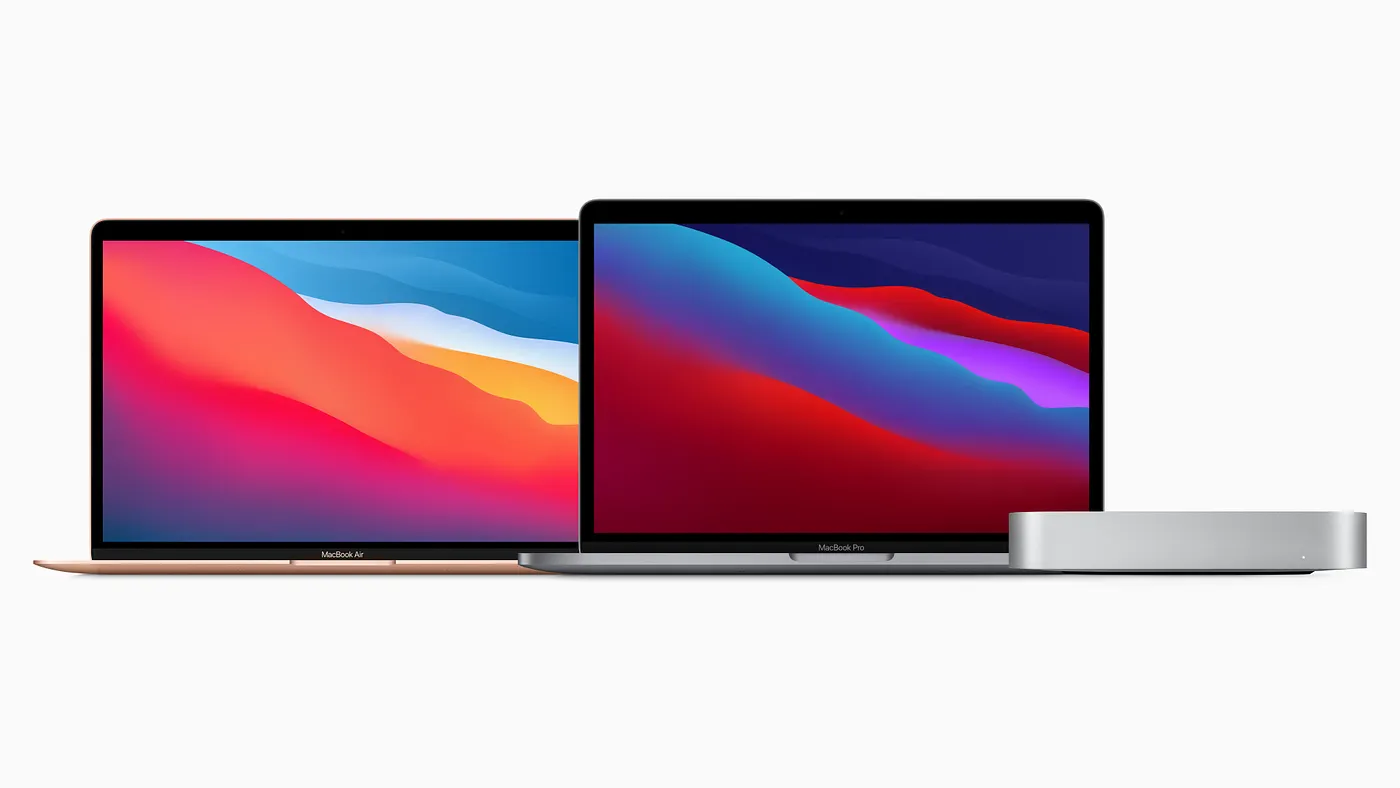
<img src="/media/articles/1*BHsGTGLTz8xEOT_H3ssL9w.jpeg" alt="It’s the M1 family! Of course, the new arrivals, the iMac and the iPad Pro are not pictured." />
<figcaption>It’s the M1 family! Of course, the new arrivals, the iMac and the iPad Pro are not pictured.</figcaption>
</figure>

<p>Apple talks a lot about being “revolutionary” and making major strides in areas that have something similar already present, and it shows in their product launches a lot. Their own commentary on how <feature> is unique and new is consistently undercut by them following it up with something like “for the first time on <product>”. As an Indian, it was downright hilarious to hear Apple boasting about introducing [Dual-SIM support](https://support.apple.com/en-in/HT209044) on their phones back in 2018, because the Indian market simply does **not** have a single-SIM phone apart from the iPhone, and still, it was just eSIM, instead of just having support for two full modules. But that’s Apple for you, and while they do give in themselves to becoming the butt of jokes (headphone jacks, Dual SIM, phone widgets, folders) all too often in the communities I am part of, they are nonetheless good at making things. _I know, surprising!_ And sometimes, their revolutionary moves actually make a mark. And none quite so soon as the M1.</product></feature></p>

<h2 id="lets-get-introduced-better">Let’s get introduced better</h2>

<figure>
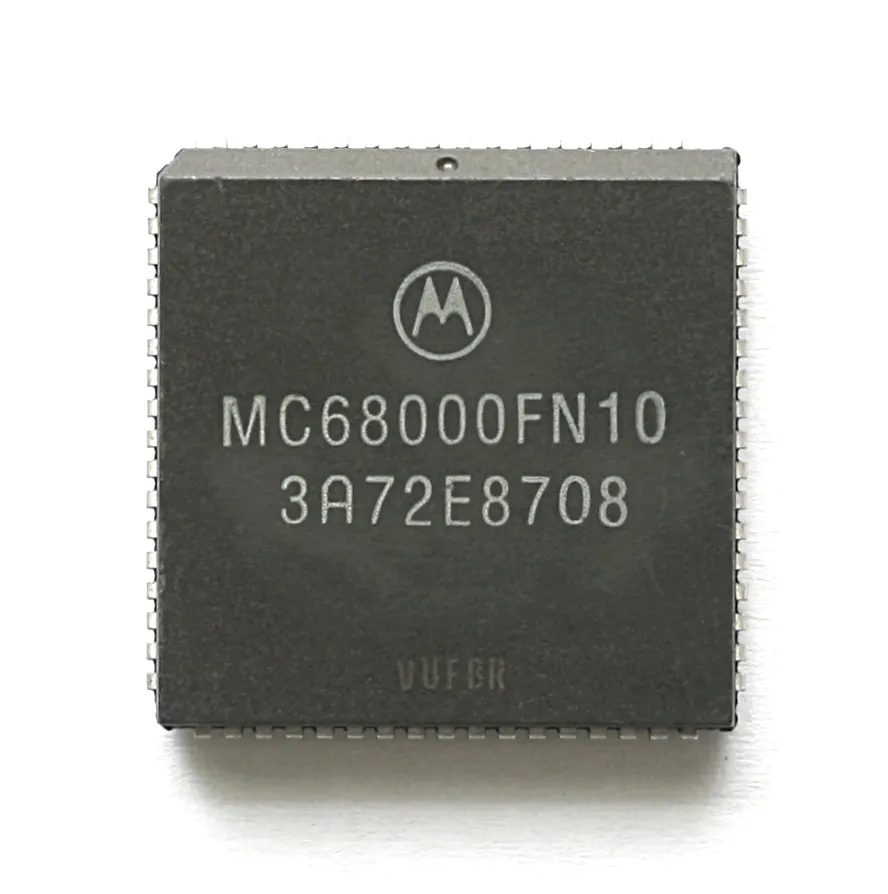
<img src="/media/articles/1*PPyjhysZfe5edXbeFKKNYw.jpeg" alt="The Motorola 68k, where Macs began. By Konstantin Lanzet — CPU collection, CC BY 3.0" />
<figcaption>The Motorola 68k, where Macs began. By Konstantin Lanzet — CPU collection, CC BY 3.0</figcaption>
</figure>

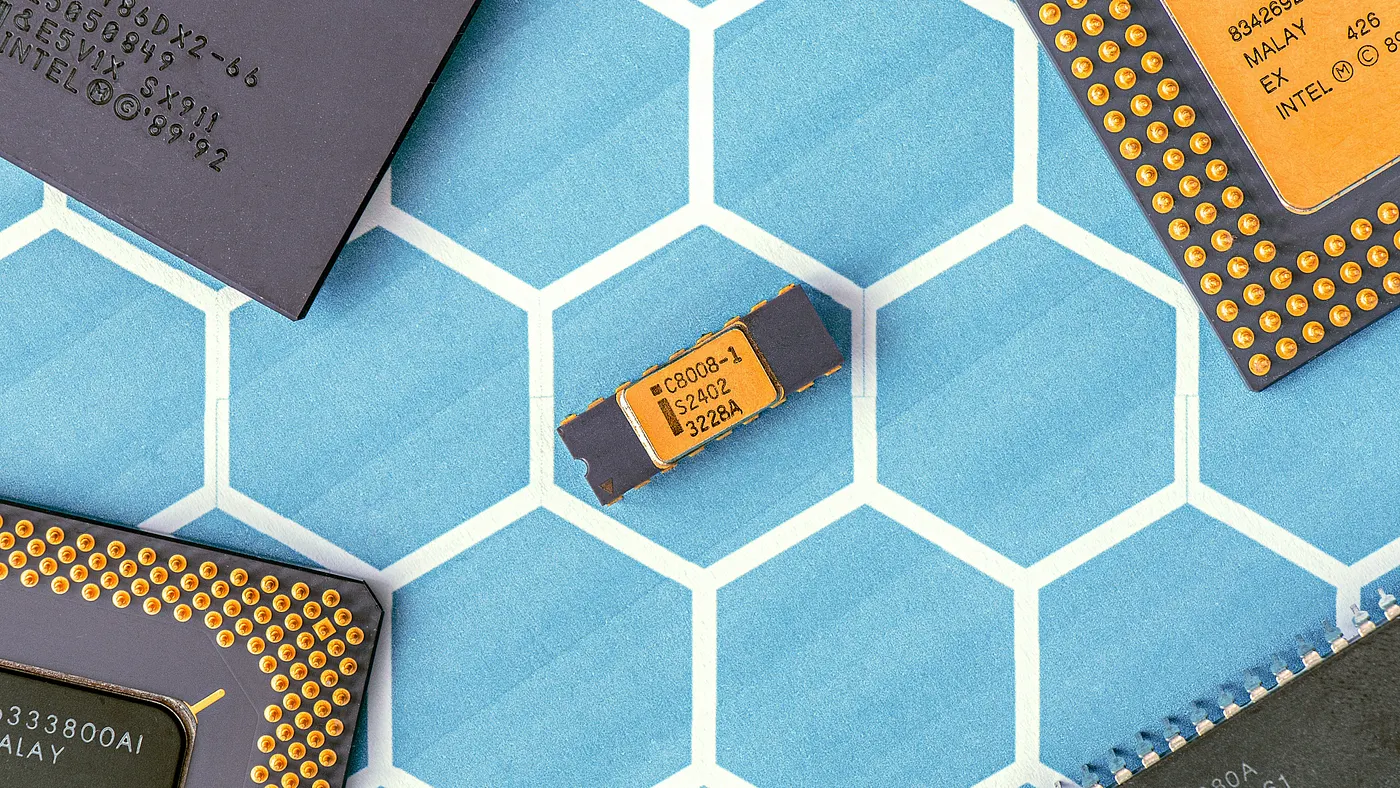
<p>Apple has manufactured several products over their long history. But their <a href="https://en.wikipedia.org/wiki/Macintosh_128K">start</a> was with the Mac, and Mac computers have been through a lot of changes. The change to watch, for now, is the CPU in them. Of late, Intel and AMD are what come to mind when you so much as utter the word “CPU” in terms of a computer. And Apple was on that very well-adopted x86 platform as well, with Intel CPUs powering every single product that ran macOS. But Apple chose to move on from this arrangement for several reasons, making in-house CPUs for their Mac devices like their iPhone and iPad chips. This eliminates their need to rely on Intel, whose Skylake and subsequent architectures and CPUs based on those architectures were a sticking point for Apple. With Intel hardware showing <a href="https://www.pcgamer.com/intel-skylake-why-apple-left/">stagnating performance gains and increasing thermal output</a> on powerful mobile devices like the MacBook Pro, Apple decided to make the move.</p>

<h2 id="not-their-first-rodeo-their-third-actually">Not their first rodeo. Their third, actually</h2>

<figure>
<img src="/media/articles/1*AdSVQ5mrQQfr6DTFpC5peQ.jpeg" alt="The PowerPC 601, one of the first PowerPC CPUs." />
<figcaption>The PowerPC 601, one of the first PowerPC CPUs.</figcaption>
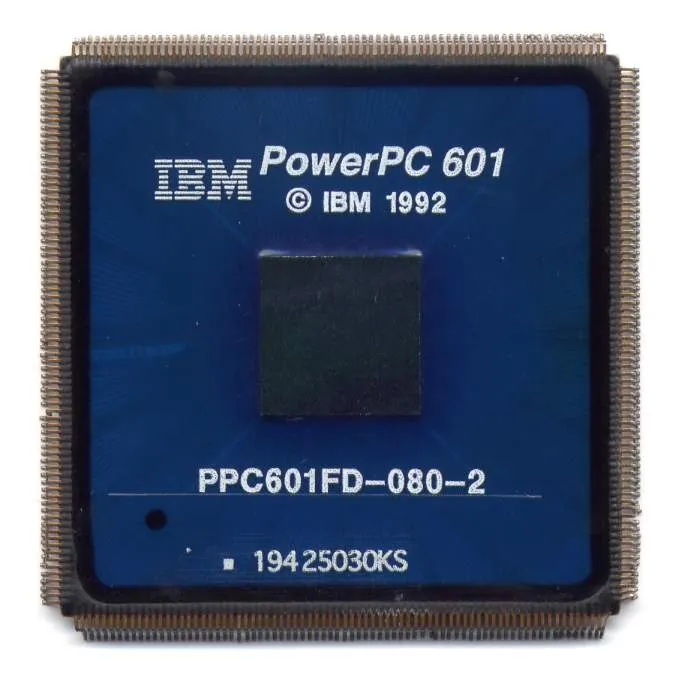
</figure>

<p>Now, Apple has been on this road before. They made a similar transition to Intel CPUs from <a href="https://en.wikipedia.org/wiki/PowerPC">IBM PowerPC</a> chips back in 2005. As well as yet another one from Motorola 68000 CPUs to PowerPC even before that, but that was a bit too long ago, so we’ll skip over that for giving the proper context for this transition without inducing tedium.</p>

<p>The <a href="https://en.wikipedia.org/wiki/Mac_transition_to_Intel_processors">transition <em>to</em> Intel</a> helps us understand what Apple’s coming from in the current transition too. We can draw a lot of parallels between both these transitions: from the reasoning that Steve Jobs (and in 2020, Tim Cook) gave in one of his signature keynotes, performance-per-watt, to the fact that rumours were afoot of Apple working on such a transition internally years before the final reveal. Even the reveal at the end where Jobs and Craig Federighi both tell the crowd that the Mac presenting the whole presentation from the start was actually an Intel/M1 device, thus emphasising their readiness to make the transitional jump.</p>

<figure>
<img src="/media/articles/1*TfII-KMGFojecuZrA6HJiw.jpeg" alt="Steve Jobs reveals and confirms the rumours around Apple transitioning to Intel CPUs" />
<figcaption>Steve Jobs reveals and confirms the rumours around Apple transitioning to Intel CPUs</figcaption>
</figure>

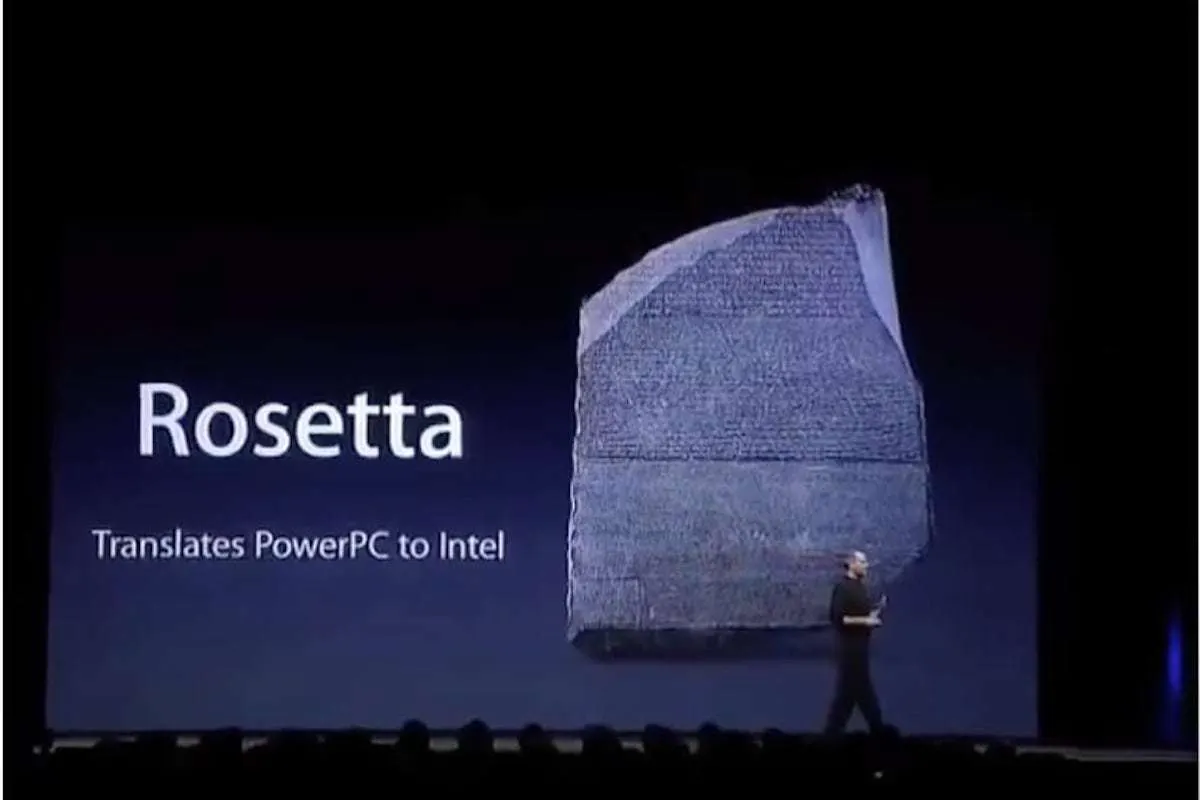
<p>Over at the backend, Apple introduced Rosetta, a dynamic binary translator that helped run apps meant to run on the old PowerPC hardware, on Intel hardware. And since Apple makes their own hardware for their own software, they could make sure that all third-party software will run only on Intel hardware in the future, and developers could focus on just one version of their app by then.</p>

<figure>
<img src="/media/articles/1*2iv984uDNi9WLftJGur5JQ.jpeg" alt="The original version of Rosetta eased the transition process to Intel CPUs. It had no GUI, it just did whatever it was supposed to do in the background. Thus, Apple called it the “most amazing software you will never see”." />
<figcaption>The original version of Rosetta eased the transition process to Intel CPUs. It had no GUI, it just did whatever it was supposed to do in the background. Thus, Apple called it the “most amazing software you will never see”.</figcaption>
</figure>

<p>To see the similarities, replace PowerPC with Intel and Intel with Apple Silicon, and you’d get exactly what Apple is doing right now. They just called it <a href="https://developer.apple.com/documentation/apple-silicon/about-the-rosetta-translation-environment">Rosetta 2</a>.</p>

<p>Apple now gains full integration of the main parts of their most popular products. They always designed iPhone and iPad CPUs in-house, relying on external semiconductor manufactures (or “fabs”) only for manufacturing, but it was still their design running with their software on top of it. With the Mac now under that very product philosophy, it is a much better experience using the native Mac apps. They seem to take full advantage of the new ARM architecture, and using them is a breeze on an M1 device. For native apps, the M1 is superlative, until Apple releases another CPU to put in the more powerful Mac devices.</p>

<p>So we know what Apple has done so far to make this move, and with help from the previous transition, we can predict parts of the future for this process. And with that down, let’s compare the last MacBooks powered by Intel to the newer ones.</p>

<h2 id="intel-vs-the-m1-not-a-one-sided-battle">Intel vs The M1: Not a one-sided battle?</h2>

<p>It is fair for Apple to advertise their M1-powered MacBooks like this in their presentations and press releases:</p>

<blockquote>
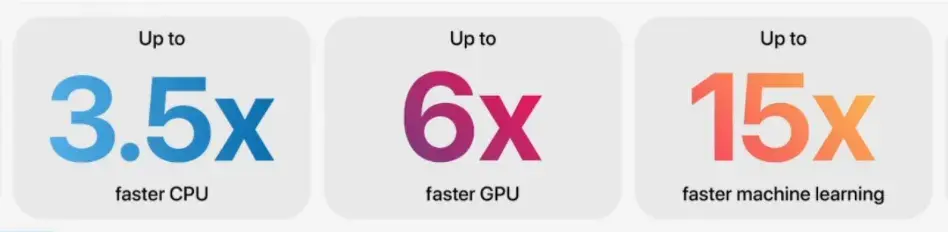
  <p>With the M1 chip, MacBook Air speeds through everything from editing family photos to exporting videos for the web. The powerful 8-core CPU performs up to <strong>3.5x</strong> faster than the previous generation. […] The [MacBook Pro’s] 8-core GPU is up to <strong>5x</strong> faster.</p>
</blockquote>

<figure>
<img src="/media/articles/1*uIFUzqv-EP6MLqvpkdMQNQ.png" alt="WHAT DO YOU MEAN, APPLE? WHAT DOES THIS MEAN? THE NUMBERS, WHAT DO THEY MEAN???" />
<figcaption>WHAT DO YOU MEAN, APPLE? WHAT DOES THIS MEAN? THE NUMBERS, WHAT DO THEY MEAN???</figcaption>
</figure>

<p>These multipliers do not make much sense on their own when looked at a little carefully. How is the GPU 5x faster? How did you measure it? Did you test that by running a game or by running a GPU-reliant Final Cut Pro render? It’s really not clear neither by looking at the press releases nor in their presentations. This lack of transparency has been a sticking point for many against Apple’s marketing, but it works for them. Thus, we have to rely on independent reviewers to put the machines to the test, faring them against an Intel MacBook to really figure out what these numbers mean. And real-life testing shows an all-around improvement in just every facet of laptop computer usage.</p>

<h3 id="endurance">Endurance</h3>

<figure>
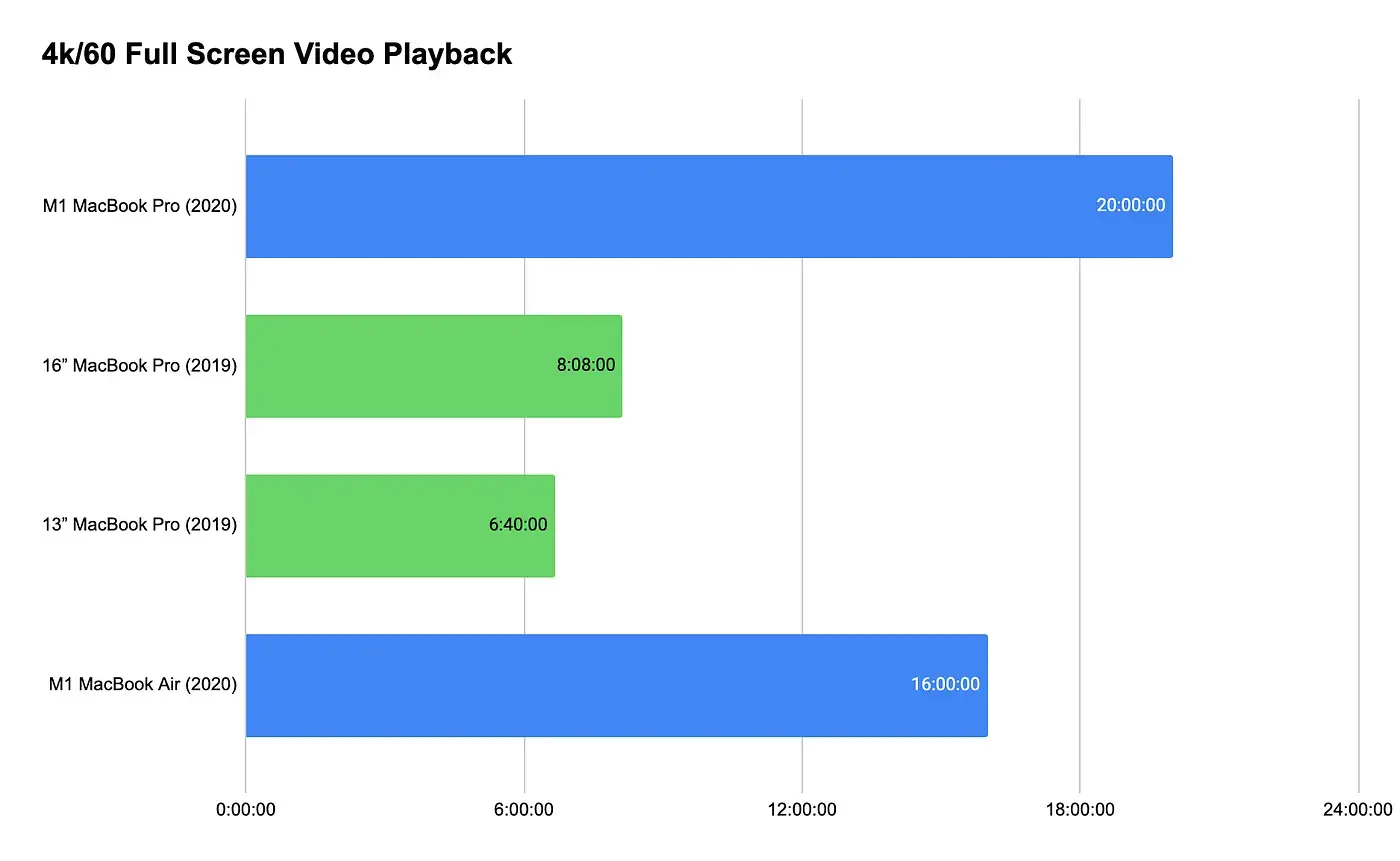
<img src="/media/articles/1*BRSDOkHoVFebL9jyYFGlqw.png" alt="The M1 MacBooks have a standout battery life, and they can run you multiple workdays of mixed usage. Source: TechCrunch" />
<figcaption>The M1 MacBooks have a standout battery life, and they can run you multiple workdays of mixed usage. Source: TechCrunch</figcaption>
</figure>

<p>For one, without a change in the battery size (hence, thickness and weight), the MacBooks the M1 shipped with initially have become endurance kings. Reviewers have reported absolutely not plugging in their laptops and still managing multiple workdays with that single charge. The Air does fall shy of the claimed 18 hours of video playback by around a few hours when <a href="https://youtu.be/KE-hrWTgDjk">tested by Linus Tech Tips</a>, but the Pro beat its 20-hour claim by lasting another hour after the 20 it was guaranteed to do. That is an astonishing number, especially when we can compare this directly with the Intel-based MacBooks because the batteries are the same. The Intel MacBook Pro went only 11 hours, a full 10 hours less than the M1 MacBook Pro. The Intel MacBook Air stayed quite close to the M1 MacBook Air, but it still was not as long-lasting. And that’s still a huge improvement because the M1 MacBooks embarrass their predecessors in raw speed.</p>

<h3 id="pace">Pace</h3>

<figure>
<img src="/media/articles/1*9utQLZb6IRQmFaPC-yihlA.jpeg" alt="For those uninformed about GeekBench scores, the single-core numbers beat every single Intel CPU that went in a Mac, ever. TechCrunch." />
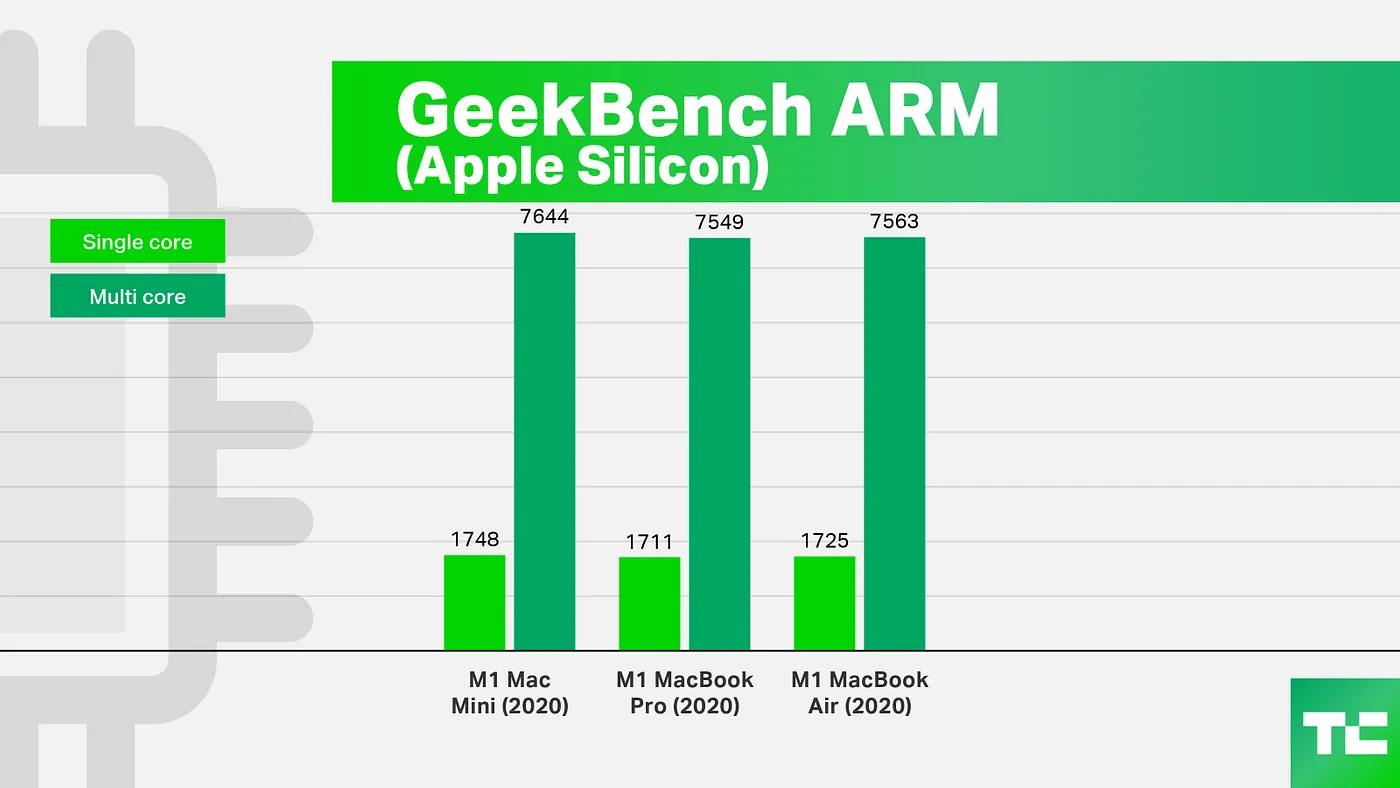
<figcaption>For those uninformed about GeekBench scores, the single-core numbers beat every single Intel CPU that went in a Mac, ever. TechCrunch.</figcaption>
</figure>

<p>Speaking of “speed”, Mac users and developers had to contend with the new ARM architecture of the M1, which could have been seen as a challenge for all, as a new architecture means that a lot of work is required for every app to work as it did before on the Intel Macs. There was Rosetta 2, though, that eased the transitional period, and it worked wonders in avoiding users, or developers, feel compromised while Apple executes their transition. Looking at benchmarks of popular applications, there were very few instances where one could even feel like anything has changed, or if there has been, it’s worthy of being called a downgrade in any way. In this manner, Apple had outdone even themselves, as they did better than last time.</p>

<figure>
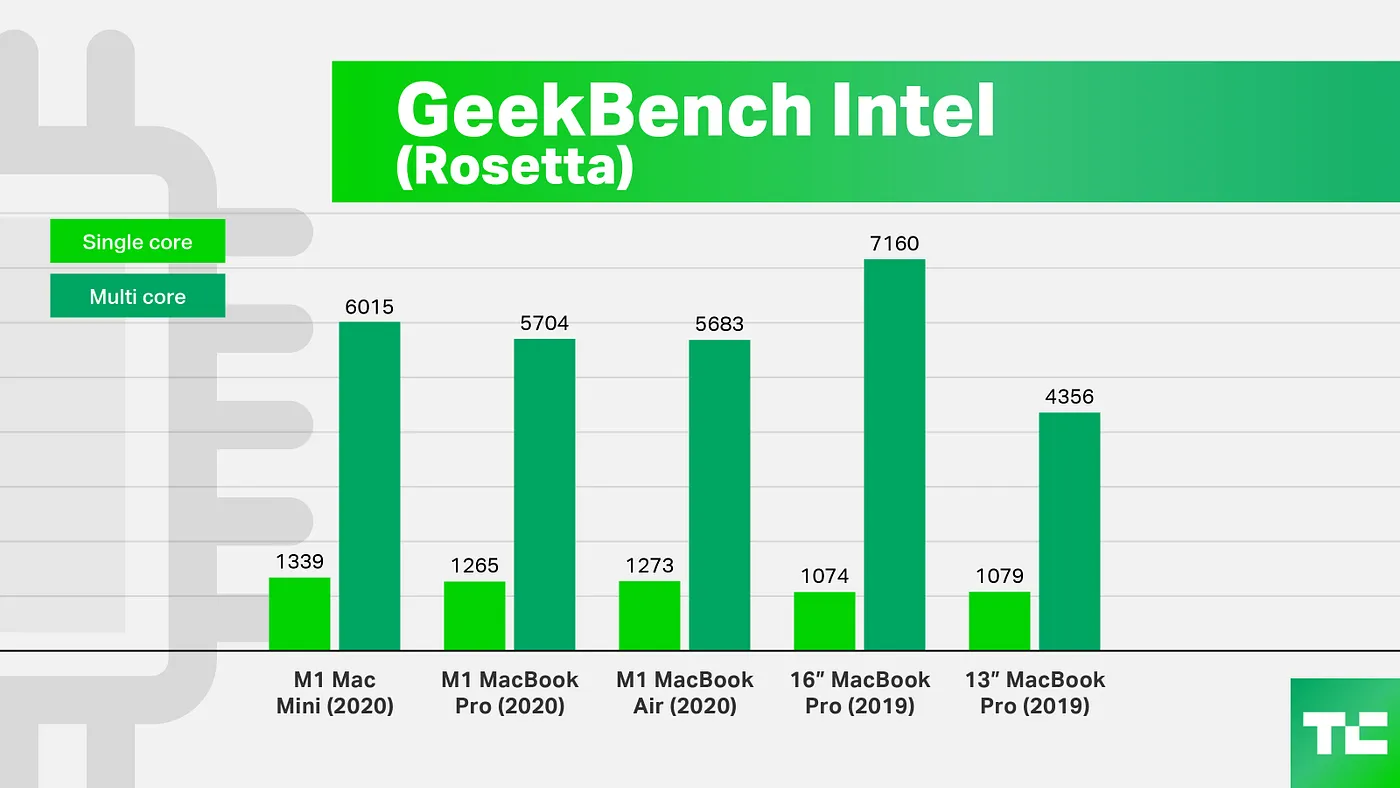
<img src="/media/articles/1*MutkCgFhDYxjXhw0fv4joA.jpeg" alt="Even if someone took the GeekBench utility meant to run on Intel CPUs and went through Rosetta 2’s translation process to run it, the performance penalty is so little that the M1 Macs still beat the outgoing Intel models." />
<figcaption>Even if someone took the GeekBench utility meant to run on Intel CPUs and went through Rosetta 2’s translation process to run it, the performance penalty is so little that the M1 Macs still beat the outgoing Intel models.</figcaption>
</figure>

<p>The M1 MacBook Pro and MacBook Air was pit against the Intel Macs they succeeded in applications that had to run using Rosetta 2 because developers weren’t finished with bringing native ARM support to their macOS apps. The M1 proved to be so good with emulation that whichever apps ran, ran better than on the native machines! Now it is certain that developers will move fast to support the M1 natively without Rosetta 2, but it will not be a painful wait for any users who already have the newer CPU in their still shiny new machines. Most observers have said that if M1 isn’t “ready”, it definitely is “almost ready”.</p>

<p>This is Apple pretty much completely eliminating the “early adopter tax” for people who have already bought the newer machines, letting them move immediately to the new paradigm Apple is shifting towards, without much inconvenience. Benchmarks show that the Intel-based MacBooks are being outrun by their successors, as one would normally expect. Most games supposedly run, although not many people are gaming on a Mac anyway. Apple has managed to <em>improve</em> on raw performance while also redefining the roadmap of the Mac on their own terms with a lot of potential to improve further.</p>

<h3 id="momentum">Momentum</h3>

<figure>
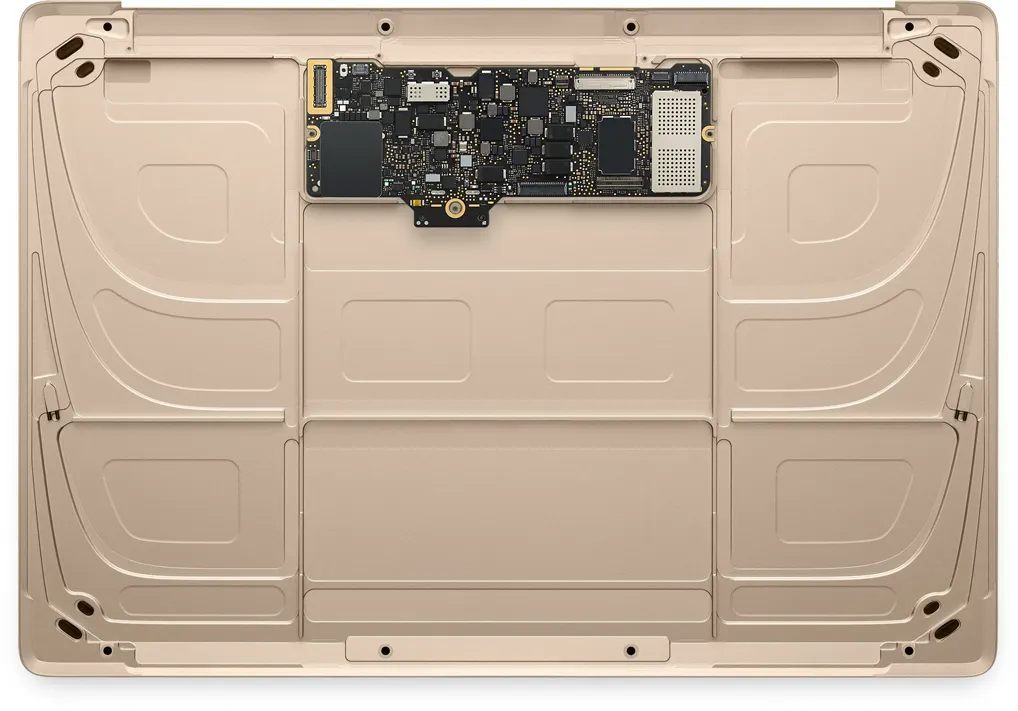
<img src="/media/articles/1*Va9k4FdQhVfteiQtgrl13A.jpeg" alt="Removing the battery cells, the 2015 Apple MacBook was all of this. The whole motherboard sans a fan is minuscule. But the performance was similarly anaemic. Photo Credits: Anandtech" />
<figcaption>Removing the battery cells, the 2015 Apple MacBook was all of this. The whole motherboard sans a fan is minuscule. But the performance was similarly anaemic. Photo Credits: Anandtech</figcaption>
</figure>

<p>Apple has made fanless laptops before, with the 2015–19 MacBook being the most recent example. But they always came with a lot of compromises. To get the noise reduction that comes with being fanless, one had to leave behind any semblance of decent performance, because the Intel CPUs in the fanless MacBook were just 4.5W parts. For anything even remotely stressing on the CPU, that MacBook was a poor performer. Apple knew it though, and they intended that laptop to be a more premium and more compact version of the MacBook Air of that time. Regardless, having that laptop was a heap of compromise, with mostly just the fanless design and minuscule weight to speak for it.</p>

<figure>
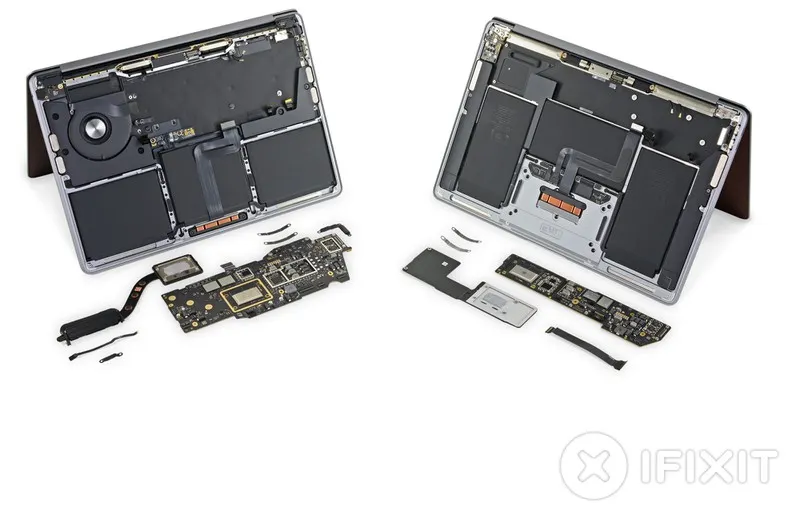
<img src="/media/articles/1*Jt0jDe4z84h4sj5IQA8vWQ.jpeg" alt="Same laptop, different internals. The lack of a fan leaves you with more space to work in a larger battery cell, or even bring back more ports! Apple would call them “legacy” I/O, but imagine having USB on your MacBook. Even Magsafe could return! Image by iFixit" />
<figcaption>Same laptop, different internals. The lack of a fan leaves you with more space to work in a larger battery cell, or even bring back more ports! Apple would call them “legacy” I/O, but imagine having USB on your MacBook. Even Magsafe could return! Image by iFixit</figcaption>
</figure>

<p>But the MacBook Air with the M1 is a regular thin-and-light laptop, with a 13-inch screen, a scissor-switch (the return to the better design) keyboard, and a CPU that can perform about as well as the 13” MacBook Pros’. But without a fan. The laptop is entirely solid-state and thus makes no noise. Yet, it avoids being lacklustre in performance. Compared to the outgoing MacBook Air (which is the same exterior design, but has an Intel CPU and a fan to cool it), it does just as well in heavy applications. And for lighter apps and multitasking, it is generally considered to be a better machine. All the while being the same starting price, and being totally noiseless.</p>

<p>With the Intel MacBooks, the 13” MacBook Pro was generally the better option when pit against the MacBook Air despite the higher price. This was because of the lower thermal budget of the MacBook Air forcing Apple to put different CPUs in these different models. The Air suffered from worse performance because of that. But the M1 MacBooks, as the name suggests, have the same system-on-chip. The only difference is in the GPU of the M1 having one less core in the MacBook Air, which does not create a huge difference when these models are compared. You can also still pay a little more and get the full, 8-core GPU M1 in the MacBook Air. But the base model is just $999 and is a better overall deal than the Intel MacBook Air was, now even over its 13” Pro sibling. So if I was to recommend someone a laptop, I’d just ask them to get the base MacBook Air and save good money.</p>

<figure>
<img src="/media/articles/1*uuEkcZO5D8RGMxmN_EcP2Q.jpeg" alt="Intel marketing can moonlight as horticulturists with that cherry-picking skill. But this goes both ways for marketing departments. However, the M1 impresses in the hands of an unbiased reviewer just as well, shining under scrutiny." />
<figcaption>Intel marketing can moonlight as horticulturists with that cherry-picking skill. But this goes both ways for marketing departments. However, the M1 impresses in the hands of an unbiased reviewer just as well, shining under scrutiny.</figcaption>
</figure>

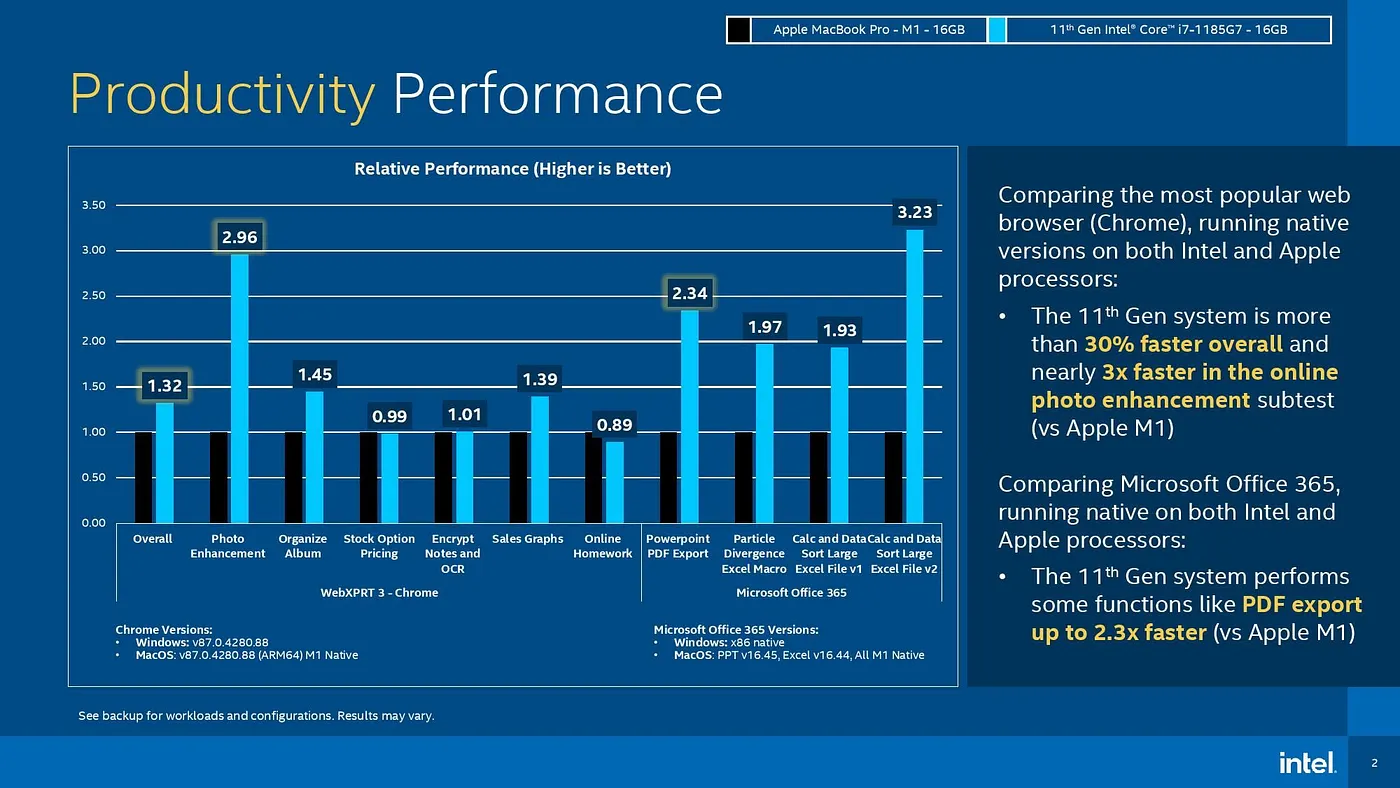
<p>Intel has responded in whatever ways they had to this upheaval. Their Evo standard of specifications — which in my opinion is just Ultrabook’s second life — and in turn was born out of Windows laptop manufacturers losing out the laptop design battle to Apple’s unibody MacBooks which were new for that time. Additionally, a bunch of first-party benchmarks came from Intel, directly pitting their 11th Generation laptop CPUs with the M1. First-party benchmarks are not worth reporting on, as we all should know. They may be correct, but data has its ways of being unnecessary whilst looking attractive, which is exactly what Intel’s benchmarks have done. We shall stick to what independent journalists have written or said about the CPUs here.</p>

<h2 id="can-we-call-the-laptop-wars-then">Can we call the laptop wars then?</h2>

<p><em>There’s still a lot to go through.</em></p>

<figure>
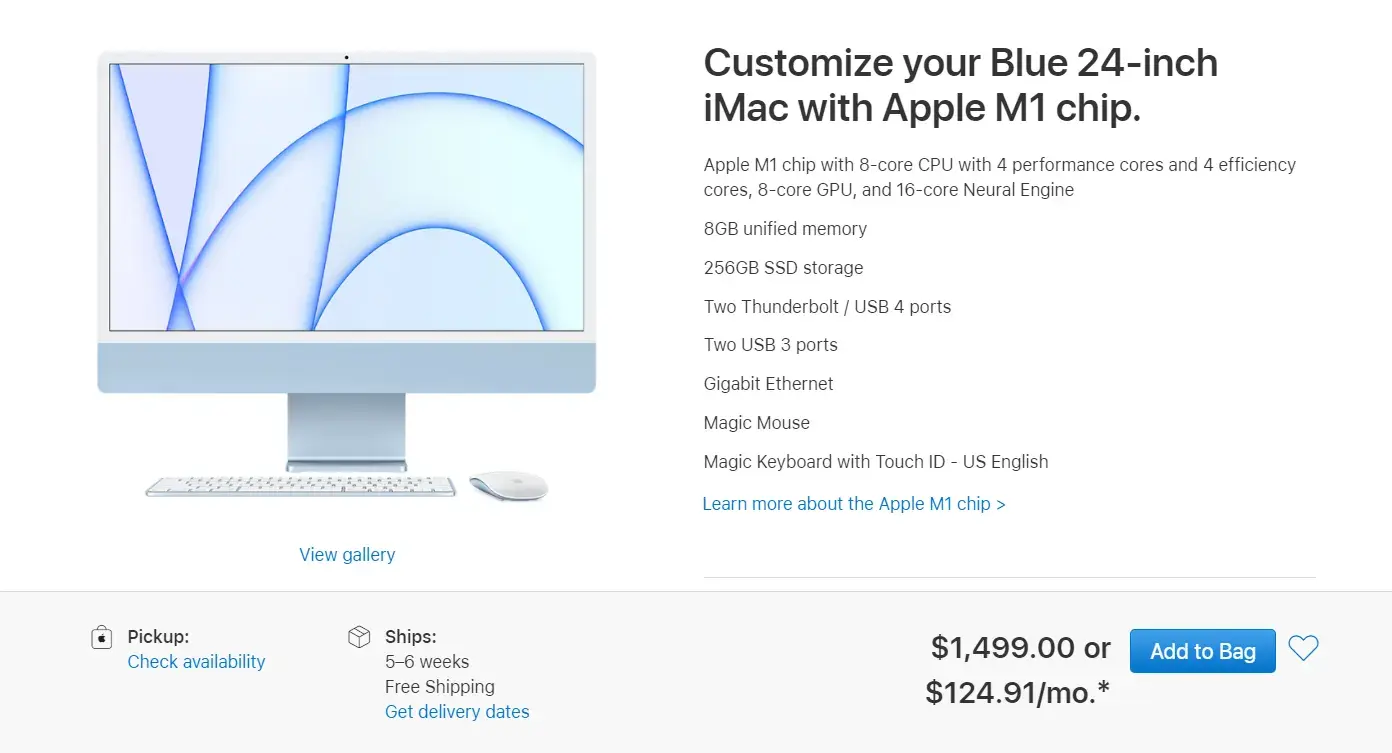
<img src="/media/articles/1*VeAzVk6swU_89uEntmCCyQ.png" alt="The M1 is still an entry-level CPU. The most expensive device with the proper M1 still starts at US$1,499, which isn’t a lot in Apple’s terms. So there is a whole slew of new products we have to wait for to have a full ARM-based lineup of Apple computers." />
<figcaption>The M1 is still an entry-level CPU. The most expensive device with the proper M1 still starts at US$1,499, which isn’t a lot in Apple’s terms. So there is a whole slew of new products we have to wait for to have a full ARM-based lineup of Apple computers.</figcaption>
</figure>

<p>Now, with the M1 in “hand”, we have a good idea of what Apple might do next, as well as what it is capable of doing with its own silicon. The M1 is a relatively entry-level part, which is the reason why it’s in the cheapest Apple computers on the market currently. But this also means that it is only a matter of time until we see more powerful versions of these new CPUs. The rumour mill is already churning out information about a redesigned MacBook lineup, a more powerful CPU for the 16-inch MacBook Pro, which hasn’t received the Apple Silicon treatment at all so far. There are even rumours of the Mac Pro getting refreshed with a significantly beefier Apple Silicon GPU (as one would expect from such a high-end computer). But we’ll have to wait for those to come and perform. For now, we can talk about Windows and PCs.</p>

<h2 id="windows-for-arm-and-arm-for-windows">Windows for ARM and ARM for Windows</h2>

<figure>
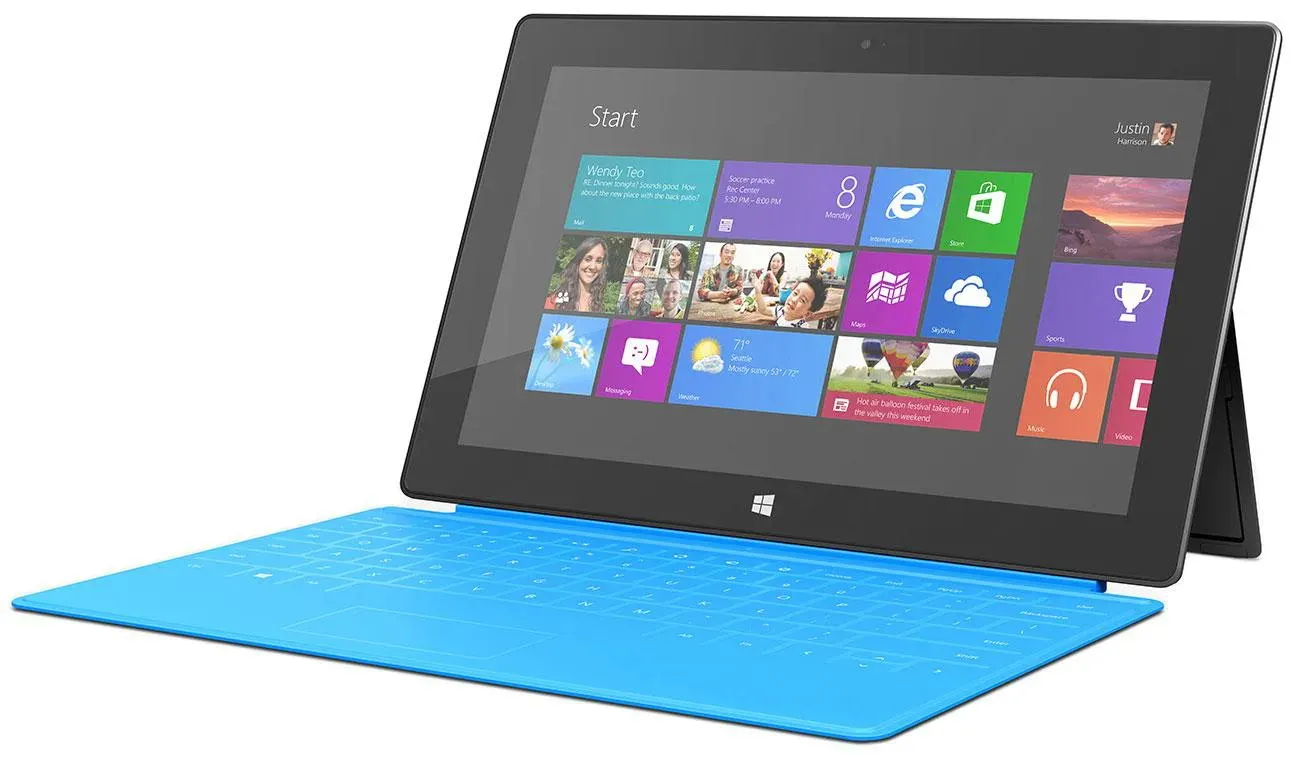
<img src="/media/articles/1*uZBZfa0InxKCk8QpiRSjtw.jpeg" alt="The Surface RT. Windows 8’s (bad) idea of the Start Screen was meant for devices like these. Of course, it failed." />
<figcaption>The Surface RT. Windows 8’s (bad) idea of the Start Screen was meant for devices like these. Of course, it failed.</figcaption>
</figure>

<p>We tend to forget this, but Microsoft was giving ARM CPUs some attention all the way back in 2012! Windows RT was a variant of Windows 8 that could run on Microsoft’s own Surface RT, the first device that was sold under that brand. However, the reason we do not hear a peep about it was that it could only run “apps”, that one could get from the new Microsoft Store. No other apps worked, not even the regular version of Microsoft Office that you may use on a Windows machine. We know how <em>widely utilised</em> Microsoft Store has been over the years, so it is no wonder why Microsoft abandoned that idea and discontinued the Surface RT less than a year later. Support continued until Windows 10, though, and RT users got the update to Windows 10 nonetheless.</p>

<figure>
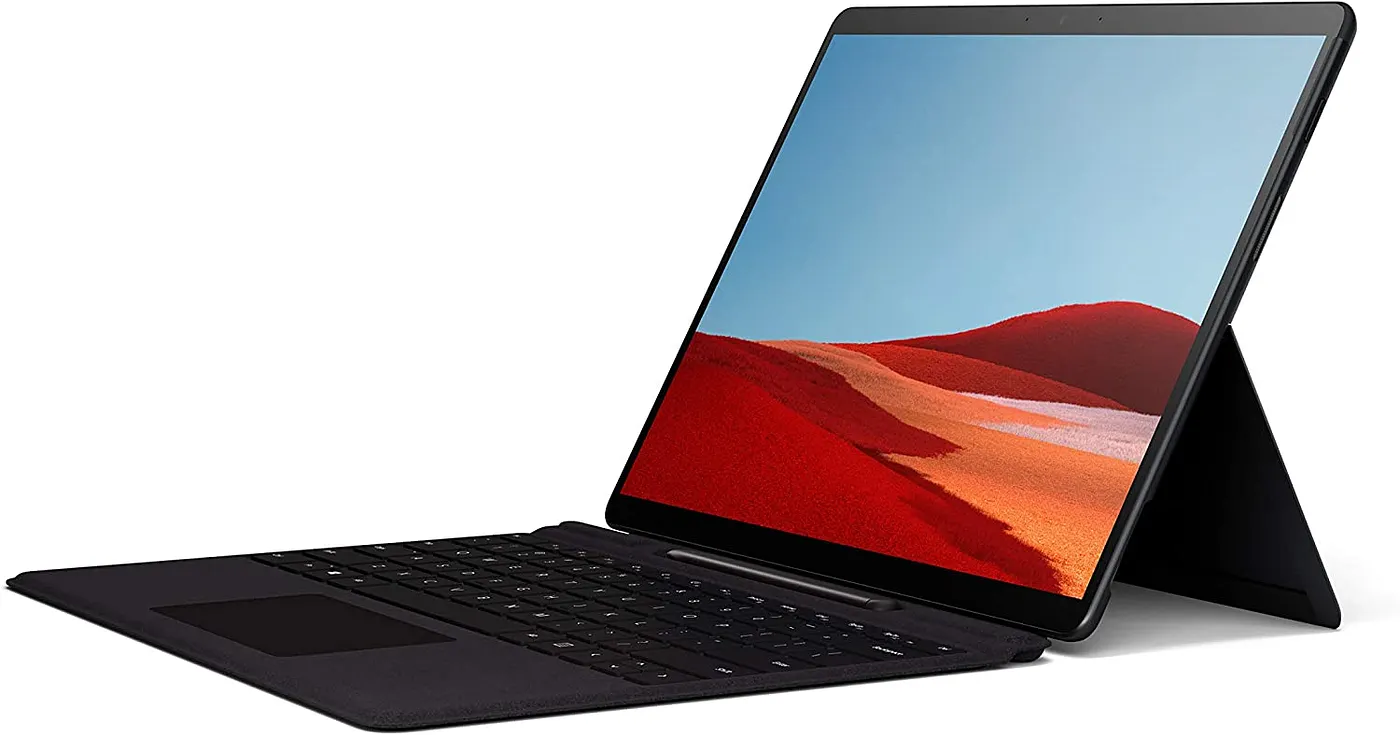
<img src="/media/articles/1*bIUYqOCPLdCsS20bfHaIqQ.jpeg" alt="Surface Pro X. Looks a lot like the RT, but it does run more apps." />
<figcaption>Surface Pro X. Looks a lot like the RT, but it does run more apps.</figcaption>
</figure>

<p>Reviving their plans later, Microsoft also made the Surface Pro X in 2019, this time with their “own silicon”, the Microsoft SQ series of chips. These were rebranded Qualcomm Snapdragon 8cx CPUs, but without further context, it does sound like Microsoft did beat Apple to the punch here. Obviously, there is more to it than just this. Back in 2019, when Microsoft (re)introduced ARM-based Surface devices, they were not so keen on letting it run “normal” software that easily. The Surface Pro X could emulate x86 apps, which are 32-bit, just like how a 64-bit x64 CPU (like the ones “normal” PCs have these days) would. That made it fit for any use case that didn’t strictly rely on 64-bit apps. Even if it did, if there was an x86 version of that app, there was no issue. This is obviously alongside any ARM Windows apps you could find. However, say you wanted to run a game or any Adobe app that would otherwise be right at home on a Windows PC, you would be stuck. Microsoft didn’t add x64 app emulation until very recently in 2021 on their ARM machine, likely seeing this as their step towards mainstreaming ARM CPUs while following Apple.</p>

<p>A clear consequence of all this was that when Apple introduced M1, most people thought that this was an entirely new approach towards making CPUs. This even includes me, as I had totally forgotten that the 8cx existed too. The Surface Pro X always stood out as a niche product that could run basic tasks, had a great battery typical of ARM-powered PCs, but lagged behind hard in anything CPU-intensive and was hard to work with due to compatibility issues with x86–64 apps. But the fact that Apple did the same thing as Microsoft after them and still managed to capture a way better mind share of the industry and market stands out as a major missed opportunity. Not just for Microsoft, they are just an example. Other brands too, like Samsung, made the same mistakes and marketed their ARM laptops as nothing more than glorified Chromebooks that will hinder most workflows.</p>

<blockquote>
  <p>[E]mulation [on Windows for ARM] is steadily improving to support a broader — if not complete — range of software.</p>

  <p><a href="https://www.techrepublic.com/meet-the-team/uk/mary-branscombe/"><strong><em>-</em></strong><em>Mary Branscombe</em></a><em>, TechRepublic, “</em><a href="https://www.techrepublic.com/article/windows-on-arm-this-is-how-well-64-bit-emulation-is-working">Windows on Arm: This is how well 64-bit emulation is working</a>”</p>
</blockquote>

<p>I believe that Windows will catch up eventually. It is just a matter of time when brands like Lenovo will come out with a ThinkPad X1 with an ARM CPU inside it and so the cycle will begin. But it has to be Microsoft that has to first make sure that they have an answer to <em>Rosetta</em>. It doesn’t have to be as good or smooth, especially because the install base of Windows is frankly insanely diverse in hardware, but it has to exist first. It is in their Insider builds for Windows for ARM, so it is clear that work is being done. It is even making good progress, it seems, but time will tell how good it eventually gets.</p>

<h2 id="winners-and-losers">Winners and Losers</h2>

<figure>
<img src="/media/articles/1*r03wqt2K5JwVb_BwMK_yHw.png" alt="So what about these?" />
<figcaption>So what about these?</figcaption>
</figure>

<p>There are two massive elephants in the room in the discussion about moving away from x86–64 that haven’t been given the spotlight here, until now. Intel and AMD are the only two manufacturers of CPUs for all computers we see around us. But the open nature of ARMs license is in direct opposition to the x86 duopoly. The limitations that this put on manufacturers like Apple were bound to have such consequences, and now here we are. As mobility becomes more and more important, ARM is the perfect package for it. High battery life, low thermal overheads, it really is a paradigm shift over x86 on mobile machines. x86 will not leave the enthusiast/DIY segment for now, though, but that’s another niche (a vocal one, sure) where it will be impossible to shake Intel and AMD’s domination. But again, it’s a niche they do not benefit from too greatly.</p>

<figure>
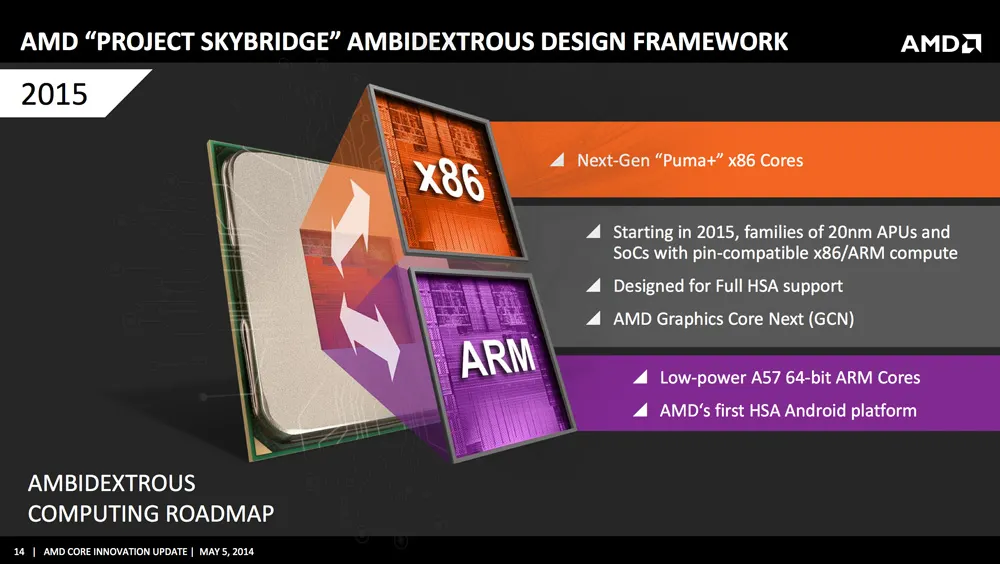
<img src="/media/articles/1*BQnkdgyk_NkQ8OFjbN6eCw.jpeg" alt="AMD tried to make a hybrid x86 and ARM platform in the years before they came out with Ryzen. The only other news we heard about it was when it was killed. But if they do have some experience with ARM, AMD may be able to bring something like this back as a response to the M1." />
<figcaption>AMD tried to make a hybrid x86 and ARM platform in the years before they came out with Ryzen. The only other news we heard about it was when it was killed. But if they do have some experience with ARM, AMD may be able to bring something like this back as a response to the M1.</figcaption>
</figure>

<p>On the other hand, these two behemoths sure will not take this lying down. But it is hard to say what they will do to counter ARM. Without being accusatory, Intel will have its ways to keep manufacturers tied to them for sure. But if they don’t compete at all with ARM in the coming future, then what will save them from losing a massive chunk of users? AMD on their end was just starting out a resurgence in the laptop market, after ridiculing Intel for the past 3 years in the desktop and server markets. They have put some stock in ARM again, directly as an answer to the M1 in fact, but those are just leaks. Only a product announcement can tell what AMD’s goals are. To keep it all concise, both AMD and Intel will surely manage. This is a new challenge for them, but they aren’t the giants they are by fluke.</p>

<p>As for winners, well it has to be the buyer. Finally, FINALLY, there is an answer to “What, if not Intel or AMD?” It has been an incredibly long time coming, too. The market isn’t cornered anymore. It will take a little while to actually realise these developments, but like when AMD stepped up the game with Ryzen, it is a good thing overall for the user. A good product is developed under competitive conditions.</p>

<h2 id="back-to-apple">Back to Apple</h2>

<p>To wrap this all up, Apple’s play here seems to have a lot of potential in the future, and the fact that it is Apple who did it drives the industry to also respond. Apple buyers are sure to get a lot more from their computers from here on, and it also seems likely that Windows users will also see some progress in a similar manner. We must wait, but what we have already seen is that Apple has pulled a brilliant move, and even people not usually convinced by Apple (me) are turning heads in marvel. It even can put a dent in the Intel-AMD duopoly over the CPU market, and cause further competition in the industry to thrive.</p>

<p>But for now, Apple has made a much-improved product after a few years of stagnation and seems to be on a further upward trajectory.</p>]]></content><author><name></name></author><category term="medium-archive" /><summary type="html"><![CDATA[And how much will we see it affect the market?]]></summary></entry><entry><title type="html">Will Intel’s CPUs be the Best Again in 2021?</title><link href="https://ysood.xyz/articles/will-intels-cpus-be-the-best-again-in-2021/" rel="alternate" type="text/html" title="Will Intel’s CPUs be the Best Again in 2021?" /><published>2020-10-29T00:00:00+05:30</published><updated>2020-10-29T00:00:00+05:30</updated><id>https://ysood.xyz/articles/will-intels-cpus-be-the-best-again-in-2021</id><content type="html" xml:base="https://ysood.xyz/articles/will-intels-cpus-be-the-best-again-in-2021/"><![CDATA[<figure>
<img src="/media/articles/0*ZYZ00XKR3P5_n8Bh.jpg" alt="captionless image" />
<figcaption>captionless image</figcaption>
</figure>

<p>AMD has announced another series of <a href="https://www.techquila.co.in/amd-zen-3-ryzen-5000-cpu-official-details/">Ryzen CPUs</a>. Of course, we all know that by now. But to summarise it anyway: AMD seems to have improved by a fair amount once again, and this time it seems like Intel’s last stronghold — gaming, is in <a href="https://in.pcmag.com/processors/138798/amds-5600x-chip-claims-top-score-in-single-threaded-performance">danger</a> of coming right into AMD’s hands as well. There are many reasons for this happening, and there are many consequences or outcomes that Intel can make happen after this.</p>

<h2 id="when-intel-had-the-crown-of-everything">When Intel had the crown (of everything)</h2>

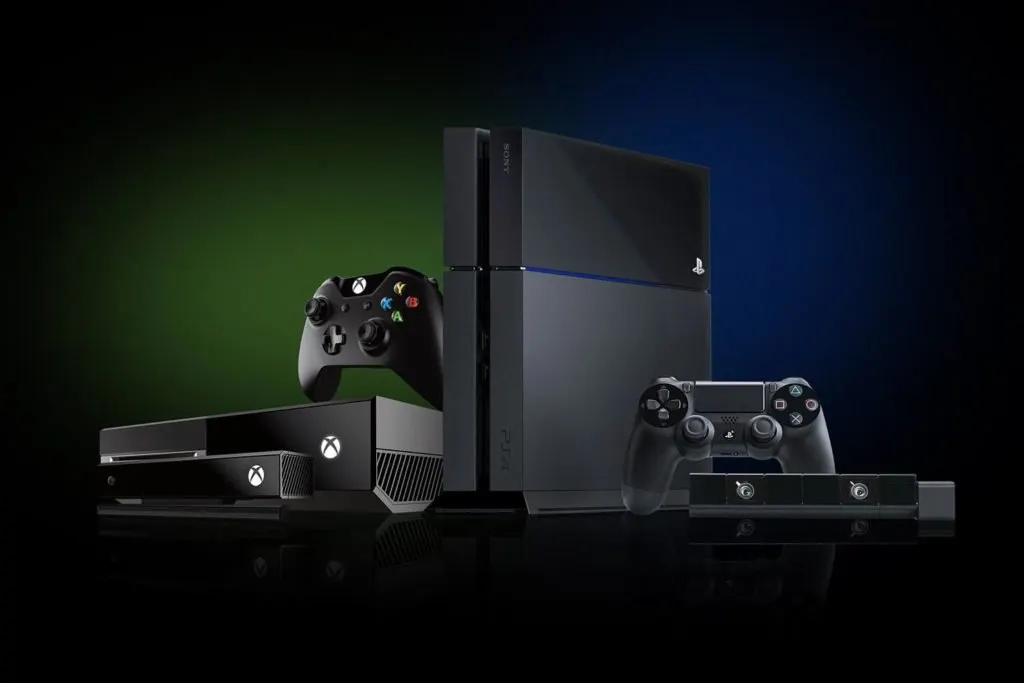
<p>AMD introduced Ryzen after it had been away from that part of the market for years, <a href="https://arstechnica.com/gadgets/2012/09/op-ed-amd-may-be-facing-irrelevance/">close to total obscurity</a>, and having nothing to compete with Intel’s best. They were kept afloat by their work on the PlayStation 4 and Xbox One consoles’ processing units (they custom-made both of them), helped in small part by the <a href="https://www.techpowerup.com/175751/apus-make-up-nearly-75-of-amds-processor-sales">less disheartening</a> sales of their lower-end APUs which were still appealing to entry-level buyers. Their Bulldozer architecture was not successful in securing any market share and struggled as well. And at that time, the period of early 2010s to 2017, Intel had monopolistic control over the higher-end market space.</p>

<figure>
<img src="/media/articles/0*JJCUywhIyhb4NI9h.jpg" alt="Both the Xbox One and PlayStation 4 used AMD custom-made processors, and developing these helped AMD a lot staying running while failing directly against Intel in the CPU market." />
<figcaption>Both the Xbox One and PlayStation 4 used AMD custom-made processors, and developing these helped AMD a lot staying running while failing directly against Intel in the CPU market.</figcaption>
</figure>

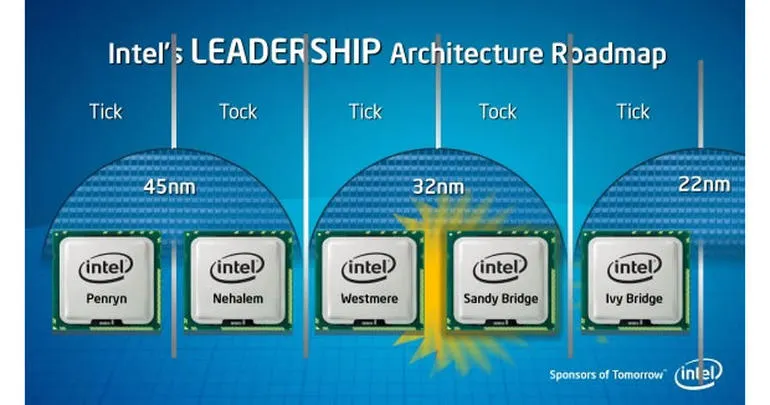
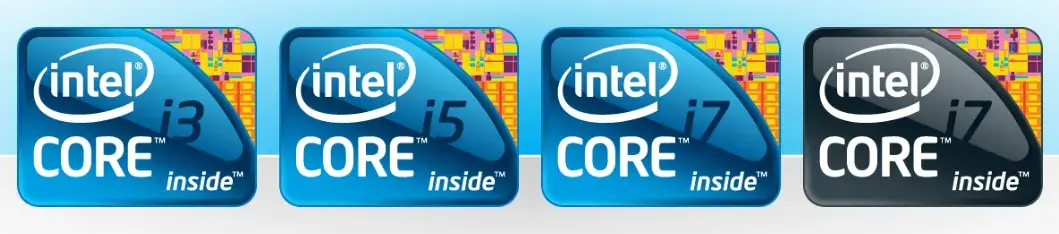
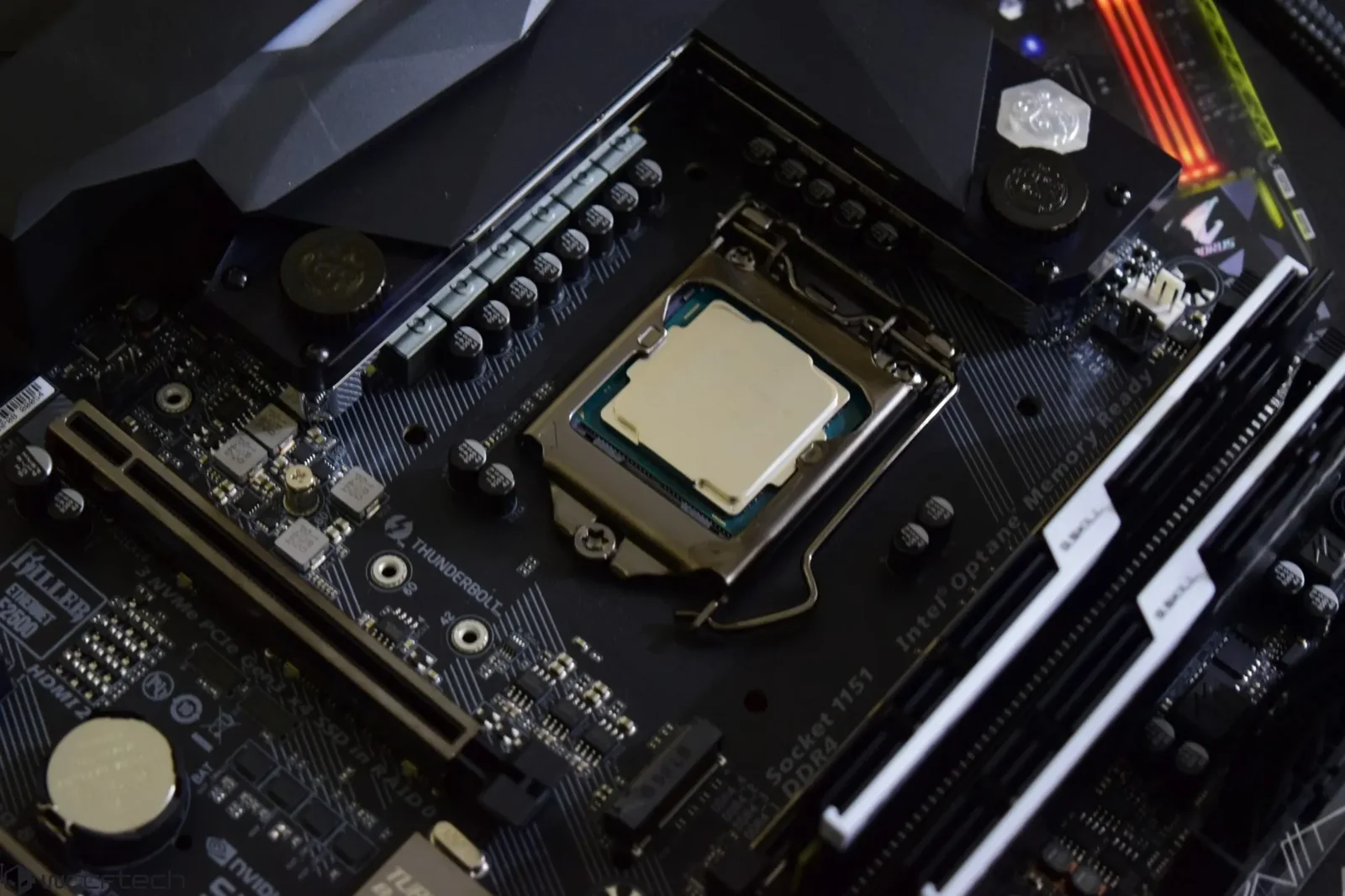
<p>Intel had the right hardware for servers, for gaming enthusiasts and for workstation-class machines as well. Their <a href="https://en.wikipedia.org/wiki/Tick%E2%80%93tock_model">tick-tock cadence</a> was on point too, it let them make advances in architecture and fabrication technology in lock-step. This aided them in being several paces ahead of their competition in AMD. They even tried <a href="https://gadgets.ndtv.com/tablets/news/intel-chips-to-power-more-than-30-tablets-in-2013-375222">competing against ARM</a> by making low-power x86 CPUs intended to be used in mobile devices like tablet PCs and potentially smartphones, although they saw <a href="https://www.anandtech.com/show/10288/intel-broxton-sofia-smartphone-socs-cancelled">minimal success</a> there. Nonetheless, Intel had made AMD look like a badly-managed, on-its-way-out company in their industry, and they were making their CPU brands some of the most solid ones out there at the same time.</p>

<figure>
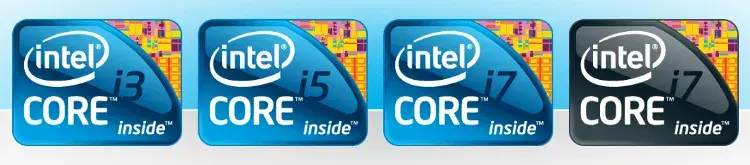
<img src="/media/articles/0*RMTeIKwXvi6XK4B6.png" alt="Back in the past, this is what the Intel CPU stickers would look like, letting you know what that machine ran, and these dominated the comparison metrics for many laypeople, and still do." />
<figcaption>Back in the past, this is what the Intel CPU stickers would look like, letting you know what that machine ran, and these dominated the comparison metrics for many laypeople, and still do.</figcaption>
</figure>

<p>At their zenith, Intel was determining the pace of the market: They chose what features would be made available at what pricing and the buyer had to make their peace with it because they were after all a monopoly at this point. And it can be reasonably argued that because of that, Intel had grown complacent enough to <a href="https://www.fool.com/investing/2018/04/16/how-intels-failures-fueled-advanced-micro-devices.aspx">stagnate the market</a>. Not bringing down features from the higher end to the midrange (thread counts, for example), making their consumer-grade CPUs more capable of workloads getting more and more prominent (like video editing and game streaming).</p>

<h2 id="intel-could-get-away-with-anything-back-then">Intel Could Get Away With Anything Back Then</h2>

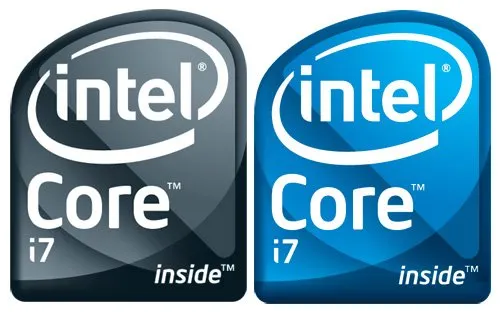
<p>An example of this stagnation is easy to be seen in core counts. Intel divided their consumer-grade CPU lineup into three categories (i3-i7) and added the “Extreme” moniker to their prosumer (higher-end consumer/professional usage) i7 chips, which ran on a <a href="https://ark.intel.com/content/www/us/en/ark/products/64015/intel-x79-express-chipset.html">more expensive platform</a> and cost up to <a href="https://ark.intel.com/content/www/us/en/ark/products/63696/intel-core-i7-3960x-processor-extreme-edition-15m-cache-up-to-3-90-ghz.html">nearly double</a> of what the best standard i7 would be priced at. From the first-generation “Westmere” i7 Extreme Edition from 2011 right to 2016’s “Broadwell-E” i7 Extreme Edition, Intel increased the core counts from 6 to 8 cores. <strong>That was it.</strong> If you wanted more, the usual route would be to buy even more expensive hardware, go to the Intel Xeon platform and use those CPUs, riddled with compatibility issues with other hardware because they were meant for enterprise deployments.</p>

<figure>
<img src="/media/articles/0*qo6vnf6oL1EsfWxH.jpg" alt="The black sticker was to denote an “Extreme Edition” i7, and going from the standard one to this required a lot of more upgrades. Some features of the Extreme Edition CPU’s could have been brought down to the normal CPU line, but because the customer had no other alternatives, they were forced to do what Intel decided for them." />
<figcaption>The black sticker was to denote an “Extreme Edition” i7, and going from the standard one to this required a lot of more upgrades. Some features of the Extreme Edition CPU’s could have been brought down to the normal CPU line, but because the customer had no other alternatives, they were forced to do what Intel decided for them.</figcaption>
</figure>

<p>This was Intel deliberately forcing its prosumers to go with an even more expensive CPU despite having the capability to bring those necessary features to cheaper products. When AMD announced Ryzen and Ryzen Threadripper with a much higher core count for a much lower price over Intel, they jumped and released the Skylake-X i9 CPUs in <a href="https://www.anandtech.com/show/11698/intel-finalizes-skylakex-processor-specifications-18cores-44-ghz-165w-on-september-25th">response</a>, not long after the fact. Not just that, even the lowest-end i3’s and i5’s got a core count bump when later in 2017 the Coffee Lake CPUs came out.</p>

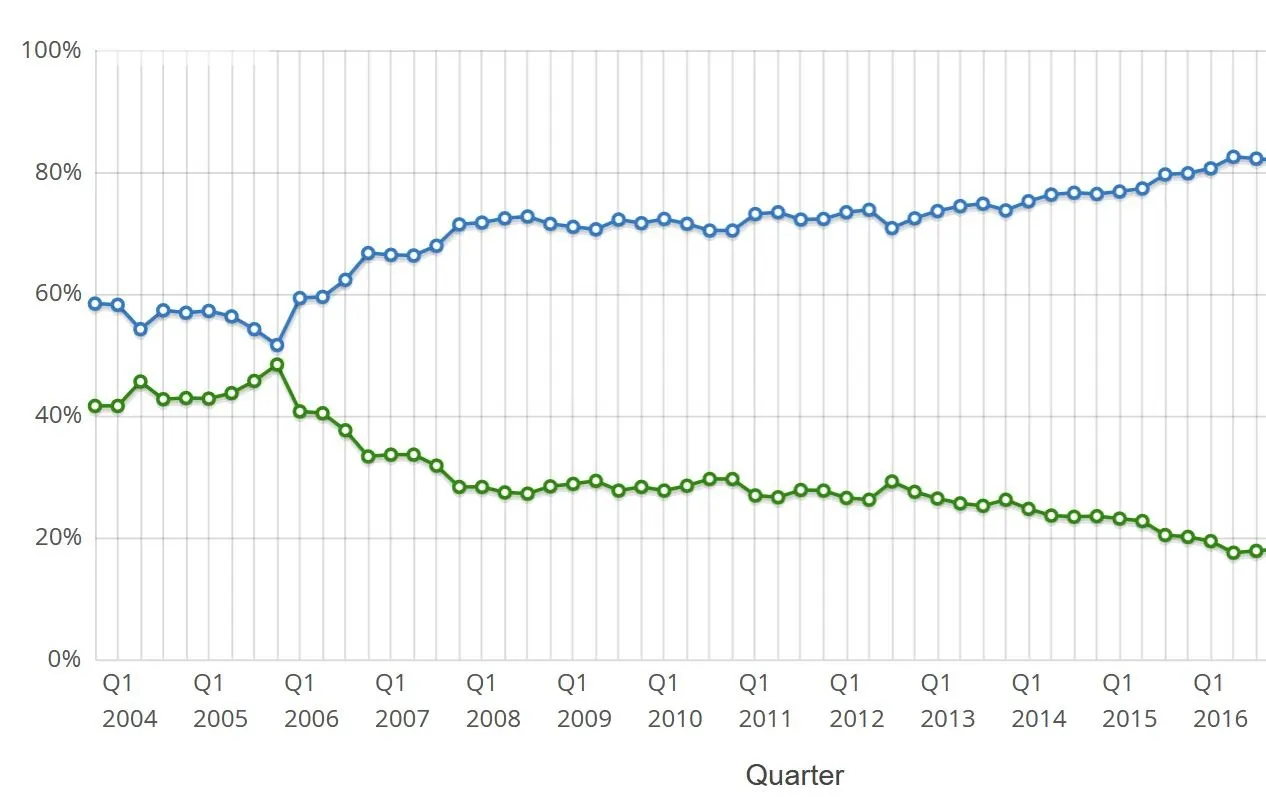
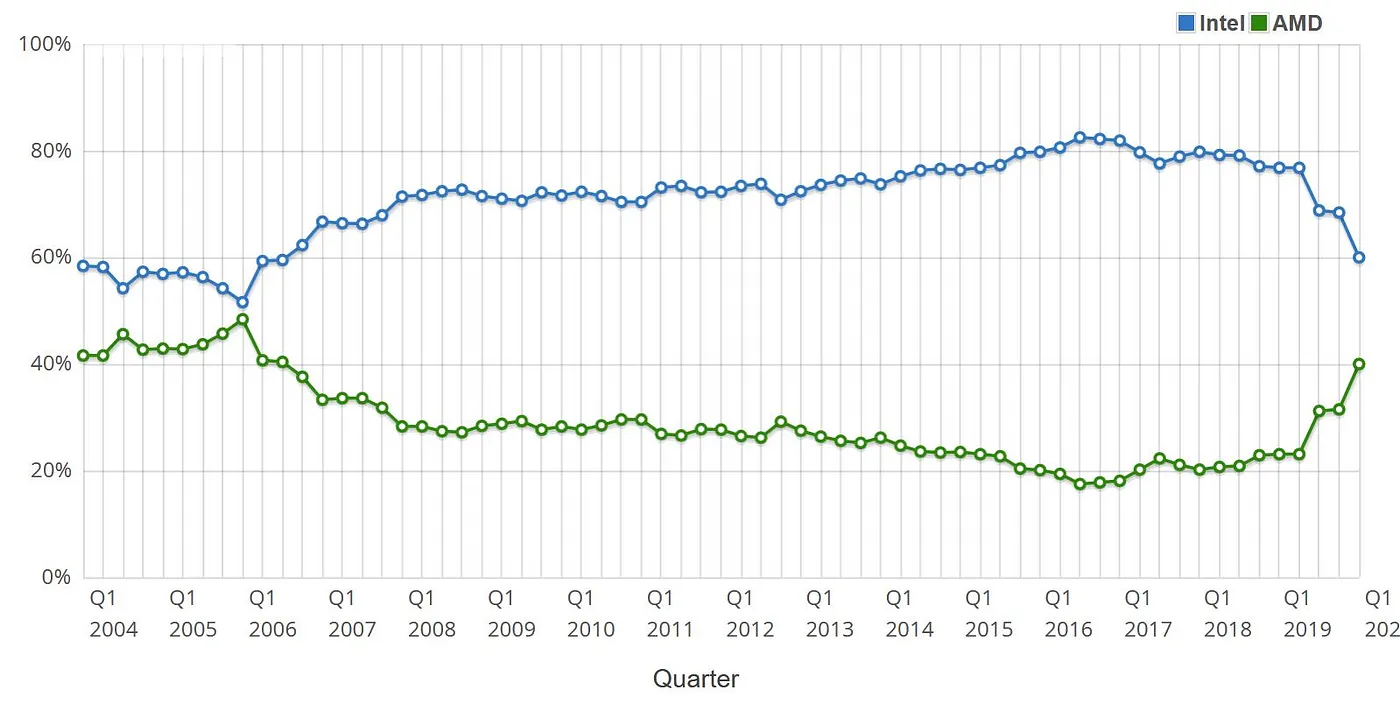
<p>AMD’s comeback did exactly what a competitive player in the market would do: it brought down costs for the consumer. With an alternative <a href="https://www.extremetech.com/computing/313500-amds-market-share-hits-highest-overall-level-since-2013">eating away at Intel’s market share</a> now, they were forced to bring everything they attempted to hold back in the years before. Now Intel was a competitor, but they were not at a disadvantage at all, at least as face value: They were (and still are) <a href="https://www.tomshardware.com/news/amd-stock-price-surpasses-intels-for-first-time-in-15-years#:~:text=AMD%20has%20a%20market%20cap,is%20worth%20in%20actual%20assets.">several times the size of AMD</a> in market value and have an impressively diverse product and service portfolio. And to affect their CPU sales more directly: They have the quality assurance and the <em>mind space</em> of the buyer already. Like how we would colloquially refer to CPUs just by their Intel branding (i3/i5/i7). Personally, it still is hard to explain to someone that my work laptop has a Ryzen 5 instead of an Intel i5 or similar. That was how impactful Intel’s branding and reach was for the past decade.</p>

<h2 id="competition-is-on-the-menu-for-intel-finally">Competition is on the menu for Intel, finally</h2>

<p><strong>So as a competitor to AMD, how did Intel fare?</strong></p>

<figure>
<img src="/media/articles/0*g08_-5ve278kc1Dl.jpg" alt="The 8th Generation Coffee Lake CPU’s from Intel were the first Intel CPUs that launched with direct competition from AMD at the time of release. These ran the 14nm architecture, and the tick-tock cadence was already broken at this point. They still were a convincing product at most price ranges." />
<figcaption>The 8th Generation Coffee Lake CPU’s from Intel were the first Intel CPUs that launched with direct competition from AMD at the time of release. These ran the 14nm architecture, and the tick-tock cadence was already broken at this point. They still were a convincing product at most price ranges.</figcaption>
</figure>

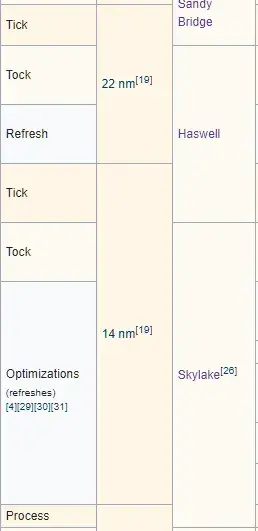
<p>An honest answer would be valiantly, but not adequately. Their problems with moving to a smaller process node came to be their undoing, forcing them back on the same 14 nanometre process <a href="https://www.theverge.com/circuitbreaker/2018/4/27/17291040/intel-10nm-cannon-lake-chips-delayed-2019-cpu-processor#:~:text=Intel%20is%20once%20again%20delaying,as%20originally%20planned%2C%20via%20Engadget.">year</a> after <a href="https://www.pcgamer.com/intels-first-10nm-desktop-cpus-are-still-a-year-awayoh-and-7nm-is-delayed-again/">year</a>, and AMD was given the opportunity to incrementally improve their products with each passing year and generation and <a href="https://www.extremetech.com/computing/313500-amds-market-share-hits-highest-overall-level-since-2013">creep into Intel’s market share</a> in both consumer and enterprise spaces. And rightfully so, because AMD was offering a consistently superior value with their product stack each year that kept on evolving with each new series of CPUs, while Intel had some specific uses for their CPUs they were aggressive to advertise and market to keep their stranglehold on the market.</p>

<figure>
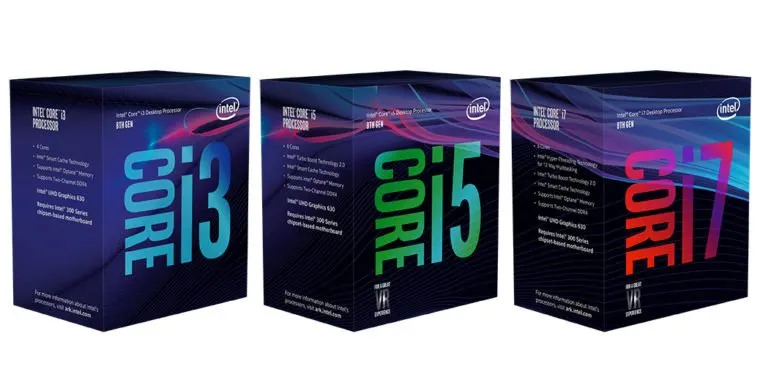
<img src="/media/articles/0*2Dm2kZv7EdmqDLWD.jpg" alt="The Coffee-Lake Refresh was the 9th Generation Core architecture, released in 2018. This time, Intel reused the i9 branding for the 9900K and its variations. This product was from a segment Intel didn’t have a product in previously, and its claim to fame was its unparalleled and undisputed superiority when it came to gaming performance, and obviously, the very iconic packaging." />
<figcaption>The Coffee-Lake Refresh was the 9th Generation Core architecture, released in 2018. This time, Intel reused the i9 branding for the 9900K and its variations. This product was from a segment Intel didn’t have a product in previously, and its claim to fame was its unparalleled and undisputed superiority when it came to gaming performance, and obviously, the very iconic packaging.</figcaption>
</figure>

<p>Intel had enough time, however, to get going with a response to the first generation of Ryzen. <a href="https://www.anandtech.com/show/11859/the-anandtech-coffee-lake-review-8700k-and-8400-initial-numbers">And they indeed did</a>. The 8th generation Coffee Lake CPUs came with more cores across the board, for one. This was aside from the general improvements that came with a new Intel microarchitecture each year. On the higher end, Intel did finally bring down up to 18 cores in one CPU to a consumer platform as in the i9–7980XE, as part of their Skylake-X lineup for those CPUs. Therefore, if Intel’s delays with their 10 nm architecture, their next lithographic step, were sorted well in time for their succeeding release cycle, Intel could easily come out on top once again.</p>

<h2 id="the-advantages-given-by-coming-out-on-top">The Advantages Given By “Coming Out on Top”</h2>

<p>Intel was not the competitor with a new product, as we have established. They were the older player here, and as alluded to before, they were completely dominant in the minds of the buyers. Every <a href="https://www.gamersnexus.net/guides/1715-best-cpus-for-gaming-buyers-guide">media outlet</a>, <a href="https://www.anandtech.com/show/7189/choosing-a-gaming-cpu-september-2013/10">guide</a> or seller was recommending an Intel CPU. And this leverage over any competition coming from the other end is what Intel could very comfortably rely on every release cycle. Now, if the successors to Coffee Lake and Skylake-X as well were leaps ahead of AMD’s offerings that were beating Intel in <a href="https://www.anandtech.com/show/11697/the-amd-ryzen-threadripper-1950x-and-1920x-review/21">many use-case benchmarks</a> as well as on price in many instances, Intel could gain that influence back in the desktop PC space. This lead was still being enjoyed by Intel in the laptop market because there were no Ryzen Mobile offerings back then.</p>

<p>But what did Intel do instead? Unfortunately, they faced another <a href="https://www.pcgamer.com/intel-cpu-roadmap-all-the-lakes-from-14nm-to-7nm/">roadblock</a> in shrinking to 10 nanometers wholesale and were forced to refresh their Coffee Lake CPU’s going into the ninth generation. They also brought the i9–9900K, a higher-priced 8-core CPU to lead their lineup. It was marketed as the “best gaming CPU”, and benchmarks proved that indeed it was. However, benchmarking was controversial, especially the one that Intel provided to media before the CPUs actually were released. Intel commissioned a firm, Principled Technologies, to <a href="https://www.principledtechnologies.com/Intel/PC_gaming_processor_study_101218.pdf">benchmark</a> their CPUs against the Ryzen CPUs of that time, instead of just providing pre-release samples of their hardware to press outlets for them to cover it. It was discovered that the firm had unfairly misconfigured AMD CPU’s in their testing (video below), widening the difference in performance between the Ryzen 2000 series and the new Intel CPUs.</p>

<p>It was later proven that Intel <a href="https://www.anandtech.com/show/13400/intel-9th-gen-core-i9-9900k-i7-9700k-i5-9600k-review/23">did have a lead in gaming performance</a> over AMD’s best, but the unfair tests published by Intel without proper validation, even if the errors made by Principled Technologies were not deliberate, were Intel’s fault and was <a href="https://www.youtube.com/watch?v=D1mJMI_uaa8">construed as their undoing</a>. This was questionable behaviour from them further decreased confidence in them amongst the crowd of enthusiasts. Also, more of these enthusiasts saw more merit in <a href="https://www.extremetech.com/computing/290518-amd-announces-q1-2019-results-ryzen-rises-revenue-recedes">switching over to AMD</a>, as they provided them with a more complete package instead of excelling at the singular use case of gaming performance. But as long as their gaming performance was superior and reasonable competence at other tasks could be seen, something like the i9–9900K could still fly off the shelves. Everything from Intel apart from the top-end was in the same boat, compared to the competition. A little more expensive, a fair bit better for gaming, and a little bit worse for most other workloads.</p>

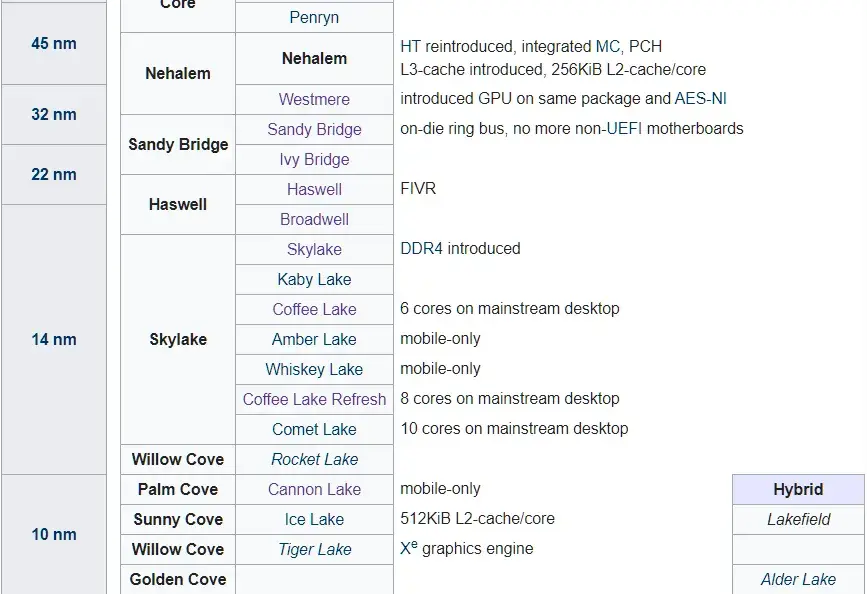
<p>What has since happened after this is a repeat of this same thing: Intel has yet another chance, but they have still squandered it because of problems with new processes. The 10 nm process <a href="https://www.theverge.com/2019/5/28/18639317/intel-10nm-10th-gen-core-ice-lake-cpu-processor-laptop-launch-thunderbolt-3-sunny-cove">made it</a> to their laptop CPU’s, owing to their lower production volume. But desktop was still at the clearly ageing 14 nm process.</p>

<h2 id="the-future-for-intel-or-part-of-intel">The Future For Intel (or, part of Intel)</h2>

<p>Skipping to the present, all we have in the name of the 11th Generation Desktop CPUs is an announcement of their <em>existence</em> as part of a Medium <a href="https://medium.com/intel-tech/intels-commitment-to-gaming-and-a-sneak-peek-at-intel-technology-to-come-83677833be7f">blog post</a> by Intel VP, John Bonini. That’s about what we have, though. The post was written one day before AMD’s Ryzen 5000 reveal event, leaving no doubts as to what motivated them to make this announcement in the first place. Intel’s humongous reach in the industry and their enormous size has been the only redeemer for them because from what we can currently see, Intel’s CPUs are slowly going the way of AMD in the previous decade. They won’t be called “a company on its last legs” anytime soon, because of their other ventures that are successfully sustaining their CPU division, and even their CPU division itself that still can sell to people who don’t know better. But one must wonder about the amount of mismanagement and internalised problems that have amounted to this predicament.</p>

<p>It would be sensationalist of me to proclaim Intel as a weak competitor to AMD at the moment. The past would be quick in proving it to be a complete falsehood. It would be more appropriate, however, to call out their incompetence as it is: a mess created by bad decisions and complacency.</p>

<p>What’s next then? We do not know anything at all about the upcoming CPUs apart from their existence, but older rumours would lead us to believe that these chips will still be 14 nm. As before, hopefully for the last time. Also, Intel has made significant strides in graphics, to the point where they are <a href="https://www.techquila.co.in/intels-earnings-report-xe-dg1-gaming-graphics-shipping/">now shipping</a> discrete Xe-branded GPUs in volume, per their latest earnings report for Q3 2020. Seemingly, Intel may be readying itself for a flurry of events that could constitute a full comeback to the front and this time with AMD giving it serious competition.</p>

<p><em>Originally published at</em> <a href="https://www.techquila.co.in/will-intels-cpus-rocket-lake-be-the-best-again-in-2021/"><em>https://www.techquila.co.in</em></a> <em>on October 29, 2020.</em></p>]]></content><author><name></name></author><category term="medium-archive" /><summary type="html"><![CDATA[captionless image]]></summary></entry><entry><title type="html">A Case for Piracy?</title><link href="https://ysood.xyz/articles/a-case-for-piracy/" rel="alternate" type="text/html" title="A Case for Piracy?" /><published>2020-09-10T00:00:00+05:30</published><updated>2020-09-10T00:00:00+05:30</updated><id>https://ysood.xyz/articles/a-case-for-piracy</id><content type="html" xml:base="https://ysood.xyz/articles/a-case-for-piracy/"><![CDATA[<p><em>Piracy has found its way everywhere, but the legalities and effects that relate to it are still very grey.</em></p>

<figure>
<img src="/media/articles/1*CqjlqQi_yblVMrMLy8MFuQ.jpeg" alt="credit: kohlapse on r/vexillology" />
<figcaption>credit: kohlapse on r/vexillology</figcaption>
</figure>

<p>Let’s get the memes out of the way first: “<strong><em>You wouldn’t download a house.”</em></strong> is correct. I don’t think anyone will, ever. It may be hard to put drywall through a fibre-optic cable, after all. But the messaging of the advertising campaign that created this meme, years and years later, still is a point of contention among many. “Piracy. It’s a crime” was part of the campaign that released the public service announcement, and one had to watch them before the movie played on the DVD retail disk. The message it conveyed is in the title itself, and it was straightforward: you will be caught pirating, and will be penalised for theft.</p>

<p>Piracy has since evolved with time and has utilised newer, more novel methods to circumvent any legal barriers it may be blocked by. However, it has to be noted that it has been somewhat complicated for the law to reach pirates and pirated content — not because pirates are extremely good at their job, because a lot of people pirate without paying mind to the intricacies of the laws of their regions, but due to the laws against pirated content still being uncertain in enforcement. Significant incidents of piracy done by selected groups and individuals are yet brought to light and justice, though. However, regular content consumers are among us and are still present in droves, who do not pay too much attention to trifles like legalities and such. And, in my opinion, it is not a great look to raise a hue and cry over it either. Let me explain this position of mine, as it can be somewhat controversial. I shall present some arguments based on real-life incidents, news and experiences that all lead one to question whether the “legal” way is the best after all, or not.</p>

<h2 id="why-can-i-not-own-anything">“Why can I not own anything?”</h2>

<figure>
<img src="/media/articles/1*Nzitwxpm5f1fDGSc5yRJqw.jpeg" alt="A familiar sight for someone in the early 2000s. Physical media was crucial in making legitimate purchases of software or anything digital the most viable and most autonomous method of acquiring it." />
<figcaption>A familiar sight for someone in the early 2000s. Physical media was crucial in making legitimate purchases of software or anything digital the most viable and most autonomous method of acquiring it.</figcaption>
</figure>

<p>In the days of “Piracy. It’s a crime”, one could own <em>actual copies</em> of anything they would also seek to pirate. Music for your new iPod? Yes, download it off of iTunes and save it on there! Windows XP? Yes, Microsoft sells you a copy of that. A copy of Toy Story? Get a DVD and play it on your PlayStation 2 (because it could run that!) right away! And in all these instances, once you had bought these things, you had the option to keep them safe with you, and in any manner you desire (keep it in a folder in your hard drive or store the physical media). This method of storing your “owned property” thus was legal, and you had everything you ever bought, forever. You couldn’t be arbitrarily denied access because of some technical issue, as you have a disk, an MP3 file or the executable files you need to get whatever it is you bought. Like an item of clothing, except that it gets old in a very different manner, but you still have access to it, forever. That’s a traditional approach to how economics work, and it applied to software and digital content as well.</p>

<p>To explain the scenario at the present moment, I would like you, dear reader, to note how many subscription-based services you are hooked to right now. Not the gym membership, the ones you do use. There’s Netflix, Amazon Prime, Spotify/Apple Music, and Disney+. These are just the usual suspects. The actual number goes way higher. A lot of content creators or even casual users may know of Adobe Creative Cloud, Adobe’s subscription service for their apps like Photoshop and Premiere Pro. All these are places that let you pay them a fee each month, and you could then use their services. In all the services above, you don’t get to own anything — you pay money to get nothing. Of course, you get to use the service offered, and you will get to do so in perpetuity if you pay the cost every month. But once you stop that, it’s not ours anymore. Hell, with Adobe CC, you don’t even get to access your unsaved work saved in Adobe’s proprietary file formats. We probably do not understand the detriments of it well enough. Creators of Venezuela do, though:</p>

<figure>
<img src="/media/articles/1*_uYbyfG1yIM9AuWJPseLjQ.jpeg" alt="Venezuelan Adobe CC users got this straight from Adobe, and there was no respite for them, except for, of course, pirating the software they need from then on. Credit: u/User_26 on r/piracy (Reddit)" />
<figcaption>Venezuelan Adobe CC users got this straight from Adobe, and there was no respite for them, except for, of course, pirating the software they need from then on. Credit: u/User_26 on r/piracy (Reddit)</figcaption>
</figure>

<p>Because of an Executive Order issued by President Trump in 2019 against Venezuela’s government, Adobe was forbidden to do business with Venezuelan creators. This is the first problem with current “legal” methods or a case for Piracy: <strong>You don’t own anything, and so, it will be taken away from you.</strong> It is a certainty, especially with the uncertainties of our world presently. It seems a dire measure, but for many people who pirate content even if they can stream the same content for free on Netflix or its alternatives, it is something they look at quite carefully and then choose to pirate.</p>

<p>Another instance here, and this may be a tad famous as well, is the show The Office. The US version has been on Netflix in the United States and is the primary “legal” manner to watch the show for all people in the US. Hence, many people use Netflix to watch the show. But due to a deal between Netflix and NBC, the distributors of the show, ending this year, Netflix will no longer have The Office on it anymore. It will move to NBC’s platform, making Netflix users lose access to the show, even if you have it downloaded on your devices and connect to the Internet. The subscription model can make you lose access to content in ways that are beyond your control. This makes it a more wasteful (you now buy two or more services to get your content) and a more consumer-unfriendly (stuff just, <em>goes</em>) approach to paying for something.</p>

<figure>
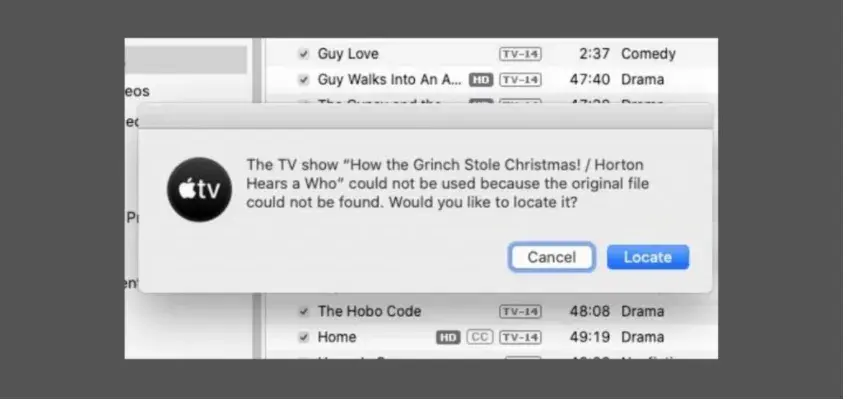
<img src="/media/articles/1*6p9COaxzBxcYVgBwlSzgmw.png" alt="Apple removed “The Grinch” from their library in December 2019, and people who had bought the movie had their purchase revoked without any compensation or refund or a replacement. Apple also released a different version of the same film, available to be purchased for the same price, again, for the people who owned the previous version as well." />
<figcaption>Apple removed “The Grinch” from their library in December 2019, and people who had bought the movie had their purchase revoked without any compensation or refund or a replacement. Apple also released a different version of the same film, available to be purchased for the same price, again, for the people who owned the previous version as well.</figcaption>
</figure>

<p>The prevalence of this model has risen in the past decade due to the increasing ubiquity of always-connected devices and online payments. It has allowed publishers and distributors to keep profiting from the same consumer(s) month after month, whilst a traditional purchase model is a one-time transaction. This benefits the distributors of content, and the consumer ends up paying a lot more in the long term. Indeed, it has made a lot of content more readily available, but for a high amount of users, it ends up being wasteful. No one will go through Netflix’s entire library, while one would indeed check out their movie purchases over a period made on Blu-Ray. Thus, the subscription model has the upside of being convenient and in some instances, cheaper, but it has several downsides, and one of them is lack of control. It does have the allure of being competitive, as multiple services now compete to produce, curate and publish original content, but what is competition in a stalemate for a consumer? With each new service, you lose access to more and more of the content you used to be able to access. That is not a competition, but a deadlock for the subscriber. You have to buy the other service as well for the content you need. Sure, you can stick with one, and buy another for a shorter period to run through their library that’s relevant to you and then stop your commitment. But the complicated nature of it is the reason why this whole model thus becomes unfriendly for the viewer, with the alternative being paying too much money for something so non-essential. And this is the only choice a user may have. The “choice between different services” is, therefore, a falsehood.</p>

<p>This lack of control and choice has been addressed by pirated content in heaps. The (extremely expensive) Adobe software suite regularly tops the charts of top torrented downloads on piracy websites. Popular TV shows from all periods keep getting repackaged with each re-release at a higher quality, in an extremely compressed form, and for newer ones, with each episode in a matter of minutes. And since torrenting is peer-to-peer networking, it is potent against censorship and restrictions. No one can block this sort of file transmission completely. And this brings us to the next section in this case for piracy:</p>

<h2 id="why-can-i-not-get-it-i-bought-what-you-bought-too">Why can I not get it? I bought what you bought too!</h2>

<p>Taking the example of The Office (US) again, I just mentioned that it is available for viewing on Netflix in the United States. But because of the nature of these deals between streaming services and distributors being region-specific, not all places have (or had) the show on Netflix. In the UK, for instance, The Office (US) was available on Netflix in 2013 but was removed by October 2015. After that, it was unavailable to be streamed legally in the UK till 2018, when Amazon Prime picked it up. For three years, the show was somewhat arbitrarily made unable to be watched legally because of agreements and such between corporations we are mere consumers for. All Netflix users in the UK who wanted the show were just robbed of it, while Netflix US still had it. A Netflix US subscriber could open their Netflix app while in the UK and find out that they no longer have the show to view themselves. This inconsistency is confusing at best, and maddening at worst.</p>

<p>How streaming partnerships get handled these days is a source for news articles, and many outlets do keep a close eye on what is “leaving” a platform and what is “coming” to one. The extent to which this locking out is done affects the popularity of a series or movie in a given region as well, which could contribute to a lot of revenue for the producers, or could rob them of it quite easily. One wouldn’t, for example, go out of their way to gain access to a series that has already concluded and is available on some streaming platform to watch if that platform is relatively unpopular or expensive. Had it been on a more popular platform, was promoted well in the service, and was maintained well with subtitles and (if applicable) all episodes available, it would have caught on much better.</p>

<figure>
<img src="/media/articles/1*72twoiypf7Mr6CYHDFW3rg.jpeg" alt="Greyed-out music files on Spotify’s India’s version. These all have been saved to the users’ library, and hence they had indeed listened to those songs before at some point when they were available on Spotify, but are now gone and unavailable to listen. Credit: @bufftrad on Twitter." />
<figcaption>Greyed-out music files on Spotify’s India’s version. These all have been saved to the users’ library, and hence they had indeed listened to those songs before at some point when they were available on Spotify, but are now gone and unavailable to listen. Credit: @bufftrad on Twitter.</figcaption>
</figure>

<p>An example that is quite familiar to me personally has to do with Spotify. In India, Spotify launched relatively late, a few years after Apple Music, its straight competitor in many ways, and several after other Indian services had already made headway in the market. In early 2019, I purchased a month-long subscription to Spotify India, after using the free US version of it via a VPN for more than 15 months, hoping to continue using it from then on. But frustratingly, I found that around 40% of my music library was unavailable to listen, and all those tracks were greyed out, impossible to be downloaded or accessed at all. Keep in mind; I had been listening to this music for 15 months now, on the same app. After some investigation, I found out that all music from the Warner Music Group (WMG) has been restricted in India for all their Spotify users, because of complications in a deal between them. I used the Indian version for a month and then went back to the free US version, and gave it another shot in early 2020, to see if this problem is past Spotify India, but it wasn’t. Only later in 2020 has it been resolved, and now India gets WMG music to listen to. Notable artists people were mentioning were absent included Charlie Puth, Ed Sheeran, Linkin Park and Daft Punk. It took Spotify more than a year to get WMG’s library to India, after delaying the release of the platform itself for more than a year before that as well, and it is only now that users can get the same thing as what they could if they would buy the subscription in the US.</p>

<p>And this all is to say nothing of the removal of singular tracks and albums that are frequent occurrences worldwide on all platforms for one reason or another related to copyright and legal barriers. This has only contributed towards increasing the absolute ubiquity of workarounds for these issues, as they can provide one with the exact thing they were trying to pay for, but weren’t getting it. For example, as I alluded to before, I use a VPN to log into Spotify in the US to get my music “fix”, and it has worked for me very well. Pirated music used to be downloaded as MP3’s once, but streaming media has reduced that extensively. It has also reduced music piracy by a tremendous amount by being more straightforward and cheaper for casual listeners. Still, as mentioned just now, even that can be a hassle for them due to “Legalese”. And thus, the second argument for piracy in 2020 is that <strong>unless you have a platform-independent method for retrieving content you have purchased, there is the possibility of it going away due to something beyond your control</strong>. And that, inherently, is not ownership at all. Piracy lets you achieve that, and many people embrace it for this reason.</p>

<h2 id="i-just-dont-get-it-here-without-dumping-half-of-what-id-pay-to-eat-this-month">“I Just Don’t Get it Here (Without Dumping Half of What I’d Pay to Eat This Month)!”</h2>

<p>This is all about the question of availability. Can you even get this anywhere? Alternatively, if you do, is it reasonable to buy?</p>

<p>Take the case of anime and manga. Japanese animated shows and comics are top-rated westwards as well, and many such series or movies have a dedicated following outside of Japan. But due to several reasons, most likely the overhead costs of doing such a thing, not many make it across the Pacific and to the rest of the world after that. Not for lack of trying, though. Netflix has made many moves to acquire rights to many anime works to bring them to overseas catalogues, while dedicated services like Crunchyroll also have their libraries for anime. But they usually have not kept up with demand or have an incomplete library of episodic programmes. This lack of supply amidst a surprisingly consistent demand is far worse with manga. Very few mangas have official English translations and the ones made my fans frequently get taken down and targeted by the publishers because of copyright issues.</p>

<figure>
<img src="/media/articles/1*HQ5s9VlvKIxj1XNg_rfwKA.png" alt="KissAnime and KissManga were shut down in August 2020 after Japan enacted stricter laws against copyright content. But a lot of the people served by the sites were not Japanese and were left with no platform to get anime and manga content at all. This was from their official Discord server, and it is indeed sad to see." />
<figcaption>KissAnime and KissManga were shut down in August 2020 after Japan enacted stricter laws against copyright content. But a lot of the people served by the sites were not Japanese and were left with no platform to get anime and manga content at all. This was from their official Discord server, and it is indeed sad to see.</figcaption>
</figure>

<p>These lead us to another reason why piracy has to swoop in: Cases where there is simply no other option. <strong>You may be willing to pay</strong>, you may be willing to pay via PayPal even when support for it in your country is sketchy at best, <strong>but who do you even pay?</strong> Manga is a great example to understand this. “Fan Translations” are reproductions and distributions of content protected under copyright, which gives publishers the authority to go ahead and fight against it being present on the Internet without their express authorisation. But, when they do that and act against these translations, they do not replace them with a version that is legal and does the same job. Manga translations are rarely published officially. Thus, what publishers end up doing is getting rid of the one method of content distribution many people are reliant on, and then failing to replace it. One egregious thing about this is that if the argument to do something like this has to do with reduced profits, then why is there no option for the legal purchase of the content they just took down? You, as a consumer, may WANT to give them your money for something you may enjoy, but they will not sell it to you. Then why is piracy bothering them at all? There is little to no overlap between consumers who would potentially buy something but are forced to pirate and the consumers who COULD buy your products at all.</p>

<blockquote>
  <p>We think there is a fundamental misconception about piracy. Piracy is almost always a service problem and not a pricing problem. For example, if a pirate offers a product anywhere in the world, 24/7, purchasable from the convenience of your personal computer, and the legal provider says the product is region-locked, will come to your country three months after the U.S. release and can only be purchased at a brick and mortar store, then the pirate’s service is more valuable.</p>

  <p><em>-Gabe Newell, co-founder of Valve, Inc. (</em><a href="https://www.ign.com/articles/2011/11/25/gabe-says-piracy-isnt-about-price"><em>source</em></a><em>)</em></p>
</blockquote>

<p>A fair amount of software publishers and indie game developers view piracy favourably, as it gives all potential users a chance to try their software out, before deciding whether they would pay money to them or not. It is a bit similar to having a lenient “Free” version of the same app and providing a user with the chance to pay if they like the thing enough. Granted, the conversion rate of such users will not be a glamorous figure, but it will be the same or worse if the software is not usable at all without being purchased. Sometimes, piracy is just a minuscule amount of exposure for developers without the means to back their creations with aggressive marketing. This also holds for something like manga and anime. These niches were explored by many through piracy, and if there is no suitable alternative to pirating it, there will be much less interest in them, if at all.</p>

<p>All these are parts of the reason why piracy is not the choice only picked by “freeloaders” or “thieves”. Some pirates are people with the means, the time, and even the “morals” to support the creators behind what they are consuming. Still, they are sometimes bound by the intricacies of distribution, and <em>“sailing the high seas”</em> is the only way around that dry, undesirable island of subscription services, arbitrary strongarming of content by providers and DRM (read below) that no one wants to be beached on, yet many seem to gravitate towards.</p>

<h2 id="on-anti-piracy-measures-parting-notes">On Anti-Piracy Measures: Parting Notes</h2>

<p><em>It is a tragedy.</em></p>

<p>There is no dearth of methods that content providers seem to come up with to reduce the ease with which something may get pirated. It was prevalent with gaming consoles, especially when CD’s became the standard media for games to be sold on, to be region-specific and have region-specific versions of games for it, or to have some check in the disc itself to verify its legitimacy. From that to Denuvo, DRM (Digital Rights Management) has evolved into frankly what is a hot mess at the moment. Denuvo Anti-Tamper is a piece of software made by Denuvo Corporation. They work in close collaboration with major game publishers to make sure their games are safe from being “cracked” or being fully reproducible without requiring a legitimate purchase record of the game. Denuvo has been vital in delaying the release of new games on torrent and redistribution websites, as it has proven to be incredibly difficult to crack by groups that work to release such workarounds (although they do not distribute the files themselves or earn anything from it at all). Denuvo has been a source of drama and has fuelled a lot of groups either out of contention entirely or to the centre-stage in the piracy “Scene”.</p>

<figure>
<img src="/media/articles/1*8DvT03ETtwLfJyhA3SRgQA.png" alt="Devil May Cry 5 pre and post-Denuvo removal. The executable file has been shrunk to a fourth of its size after removing Denuvo. However, the impact on the game’s performance was minuscule due to the effective implementation of Denuvo in this instance. This is not always the case with all games. Credits: TechPowerUp" />
<figcaption>Devil May Cry 5 pre and post-Denuvo removal. The executable file has been shrunk to a fourth of its size after removing Denuvo. However, the impact on the game’s performance was minuscule due to the effective implementation of Denuvo in this instance. This is not always the case with all games. Credits: TechPowerUp</figcaption>
</figure>

<p>But Denuvo’s success has come at a cost to the end-user. It has been proven verifiably, that Denuvo is software bloat for any user running the game at all times, as it can take up resources that otherwise would help run the game smoothly or can take up more storage space as well. Game executable files have drastically been made smaller after the successful removal of Denuvo, and users have even seen a performance boost in-game after the removal. Many publishers remove Denuvo voluntarily after the game is sufficiently old and has already been successfully cracked. Even that has helped users notice a boost in performance in the cracked game. High-profile contributors to games have also <a href="https://twitter.com/Harada_TEKKEN/status/984835707209375744?s=20">admitted</a> that it has interfered with the game’s experience for them and the end-user as well. All in all, DRM has been successful, but the purpose behind it always has been to <em>delay piracy</em>, not stop it. And it has also affected typical end-users as well in the process.</p>

<p>The existence of piracy and pirated content will not be hindered by the presence of measures against it. It is all here to stay. I cannot say much for large corporations and how they should navigate their products around piracy because I am not as qualified as their lawyers and management may be. What I can say with a reasonable amount of surety, is that measures against piracy have come into existence solely for maximisation of profit, and the more modern methods of content monetisation have led to a consumer culture that is bound entirely by smaller transactions of money that are required frequently by people willing to consume said content. Additionally, the implementation of these models has strongarmed consumers into restrictive choices and circumstances, and people who pirate now are more often than not, such people. The trope of “freeloading” has been brought into relative obscurity by these platforms while at the same time giving rise to a different user base of piracy and pirated content.</p>]]></content><author><name></name></author><category term="medium-archive" /><summary type="html"><![CDATA[Piracy has found its way everywhere, but the legalities and effects that relate to it are still very grey.]]></summary></entry><entry><title type="html">Intel’s Troubles in Shrinking Down</title><link href="https://ysood.xyz/articles/intels-troubles-in-shrinking-down/" rel="alternate" type="text/html" title="Intel’s Troubles in Shrinking Down" /><published>2020-08-07T00:00:00+05:30</published><updated>2020-08-07T00:00:00+05:30</updated><id>https://ysood.xyz/articles/intels-troubles-in-shrinking-down</id><content type="html" xml:base="https://ysood.xyz/articles/intels-troubles-in-shrinking-down/"><![CDATA[<figure>
<img src="/media/articles/1*mxlFmapMVsneuVUk-lPUAw.jpeg" alt="Intel's last 5 flagship consumer CPUs, released 2015–2019: the i7's 6700K, 7700K and 8700K and i9's 9900K and 10900K. All of them are the same process node. 5 generations of stagnation, when Intel's previous cadence meant a node change after the third." />
<figcaption>Intel's last 5 flagship consumer CPUs, released 2015–2019: the i7's 6700K, 7700K and 8700K and i9's 9900K and 10900K. All of them are the same process node. 5 generations of stagnation, when Intel's previous cadence meant a node change after the third.</figcaption>
</figure>

<p>CPU design is an extremely complex science and a complicated business. There are many ways you can lose out on something while being ahead of your competition at the same time, with the same product. That is where scientific ingenuity wins you the technical battle, and you win the “numbers game”, in a roundabout way if the circumstances are like so. But the battle of the “mind share” of the consumers cannot be won so convincingly with a technicality. You need the marketing strength behind your product for it to win over the doubtful buyer, and more importantly, the investor. So, what has Intel done (or has not) that makes it lose that fight against AMD, their only competition in the x86 CPU space? What problems has Intel faced in the recent years that make their CPU’s fall behind the competition, despite Intel being able to show, in some form or another, that buying them is still a better choice than AMD? They have kept their promise of being the superior choice for tasks such as gaming, that high-end CPU’s are very commonly used for, but for everything else, AMD has rocketed past them, and has recently come quite dangerously close to taking over in gaming as well. And it’s a popular opinion that they will go further than that as well, and will do so very soon. We need to start looking from the mid-2010’s, to understand Intel’s current position.</p>

<h2 id="what-is-shrinking-in-computer-processor-terms"><strong>What is “shrinking” in computer processor terms?</strong></h2>

<p>The idea behind a “die shrink” or more precisely, reducing the gate width of the MOSFET (Metal Oxide Silicon Field Effect Transistor) to a smaller measurement (measured in nanometres in 2020) is a process that helps processors achieve greater efficiency in operations, as they can be more densely packed with more transistors in the same area, and also reduce power lost in transmission within a MOSFET, which increases the efficiency of the processor, as lesser energy is then lost to heat. In short, the smaller the die size is, the more likely it is for the processor to be fast and adept at tasks while staying efficient and cool. With each new shrink, a new “fabrication process” is adopted to adapt to the challenges of the new technology. The very popular Moore’s Law also relates to transistor technology, as it states that the number of transistors on a dense integrated circuit — a CPU , doubles every two years, and the entire computer hardware and software industries use the Moore’s Law as a predictive model and technical goal since the dawn of modern-day computing technology. As we are quite limited in terms of how far we can take the physical size of a processor area-wise, we have to stick to Moore’s Law to plan and/or predict our processor technology and keep on shrinking die sizes to keep up with it.</p>

<p>Now, having explained the central concept of this story, let us begin with the recent history of Intel’s CPU design and marketing strategy.</p>

<h2 id="early-2010s--the-times-of-tick-tock"><strong>Early 2010’s — The times of “Tick-Tock”</strong></h2>

<p><em>Please note the “c”’s.</em></p>

<p>To try and fast-track the introduction of this piece, I will start from the first Intel Core “i” Processors. Intel’s Core series had spawned several processors, spanning different architectures and had been through several shrinks in transistor sizes, which are many, and quite stratified for different applications and so on. But their development and its planning were quite simplistically laid out by Intel, with their <a href="https://www.intel.com/content/www/us/en/silicon-innovations/intel-tick-tock-model-general.html">Tick-Tock Model</a>. It was introduced in 2007, and it follows a repetitive pattern of how Intel planned to advance their CPU’s, roughly every year or slightly more. The “tick” represented a new fabrication and process, therefore a reduction in the die size, but no change in the microarchitecture from the previous year, thereby serving as an evolutionary step for the microarchitecture before it is replaced. The microarchitecture is replaced, while the fabrication technology does not change in the “tock” in the following year, thereby serving as an optimisation of the fabrication process, so that it can take advantage of the newer process fully, before it is replaced itself by the next “tick” that released the following year.</p>

<figure>
<img src="/media/articles/1*fhbOmZiRg-1cXwOQm08zKA.jpeg" alt="An old Intel press presentation slide showing the progression of Tick-Tock. From ZDNet" />
<figcaption>An old Intel press presentation slide showing the progression of Tick-Tock. From ZDNet</figcaption>
</figure>

<p>This was Intel’s game plan for their most dominant years, a simple strategy got Intel a lot of success, as it made Intel achieve great results with their microarchitectures which seemed to get better and better with each year, and Intel was able to handily beat their competition in seemingly everything; and if not everything, it was a convincing win for Intel mostly every time. In concise terms: The Tick-Tock model was adept at pushing technologies to their maximum potential, and was successful for Intel, <em>if they were able to advance with every tick and tock.</em></p>

<p><em>Now, Intel’s naming is quite confusing, as they have one name for a new microarchitecture, as introduced in the “tock”, which also serves as the name of the step (the tock) in general. But the following step has a different name while using the same microarchitecture, as it is a “tick”, and we only see a die shrink. I hope it is not too messy.</em></p>

<figure>
<img src="/media/articles/1*yr8UEimz_3_d9dHFKZ0n3Q.png" alt="Intel’s first-generation i-series CPU stickers. The black i7 sticker is the “Prosumer” i7 CPU range, which has since been rebranded i9. These are more expensive parts, incompatible with consumer motherboards, but have a more professional-friendly feature set." />
<figcaption>Intel’s first-generation i-series CPU stickers. The black i7 sticker is the “Prosumer” i7 CPU range, which has since been rebranded i9. These are more expensive parts, incompatible with consumer motherboards, but have a more professional-friendly feature set.</figcaption>
</figure>

<p>So, Intel’s newest <em>Nehalem</em> microarchitecture was the first one that utilised the “Core i” branding, a common colloquial way of categorising Intel processors, recently a little misleadingly. It was made on the 45-nanometre node with product launches in the years 2009–10 and followed up with a shrink to 32 nm <em>(Westmere)</em> in late 2010. The Nehalem products covered the whole product stack, server (most expensive, more features for enterprise uses), prosumer (“professional” consumer, higher in performance and with more features than consumer grade, but still similar. Check picture for some more context), consumer (most common, seen in desktops of the time), and mobile/embedded (low-power, for laptops and other smaller-scale use cases). These products are, for several important reasons, not launched all at the same time, as there are tens of unique models of parts (referred to as SKU’s i.e. Stock Keeping Unit). This was an ideal execution of a complete tick-tock, as Intel had been doing for a while, and would keep on doing for some time before cracks started to show.</p>

<figure>
<img src="/media/articles/1*ZdCwxPX55jOOxTSQqznfoA.jpeg" alt="In the times of Sandy Bridge, hardware aesthetics were less of a priority. Source: Anandtech" />
<figcaption>In the times of Sandy Bridge, hardware aesthetics were less of a priority. Source: Anandtech</figcaption>
</figure>

<p>Intel executed the <em>Sandy Bridge</em> (I owned a Sandy Bridge CPU myself!) at 32 nm step similarly, a newer microarchitecture, a refresh of their entire product stack, followed by the next one, a die shrink to <em>Ivy Bridge</em> at 22 nm. These numbers are more important than the names, as these names will get more confusing very soon. One clarification in these names is the use of the second word as a suffix, making it simpler to group them. Sandy Bridge was the microarchitecture, and Ivy Bridge used the same microarchitecture, but with a 22 nm process. This also corresponds to the marketing phrase “2nd Generation Intel Core” which we use colloquially too, with 2nd Generation being Sandy Bridge, and 3rd Generation, Ivy Bridge. So far, so good. Tick-tock keeping competition <a href="https://medium.com/@yatharthsood00/the-duopoly-of-x86-331f13878085"><strong><em>(just AMD)</em></strong></a> honest, as AMD really was losing ground with their new FX series CPUs really were no match for the combination of versatility, power-efficiency, and raw performance that Sandy Bridge offered. All these factors led to enthusiasts and critics alike recommending the Sandy Bridge CPUs (most notably the i7–2600K and the i5–2500K) back in 2011, and sealing Sandy Bridge’s status as one of the greatest CPU microarchitectures in recent history, in terms of its feature set, raw performance and competitive pricing.</p>

<blockquote>
  <p>[For everyone], Sandy Bridge is easily a no brainer. Unless you already have a high-end Core i7, this is what you’ll want to upgrade to.</p>

  <p><em>-Anandtech,</em> <a href="https://www.anandtech.com/show/4083/the-sandy-bridge-review-intel-core-i7-2600k-i5-2500k-core-i3-2100-tested"><em>The Sandy Bridge Review: Intel Core i7–2600K, i5–2500K and Core i3–2100 Tested</em></a><em>, 3rd January, 2011</em></p>
</blockquote>

<figure>
<img src="/media/articles/1*eMmMac51DBwHf3fLumaOoQ.jpeg" alt="Market share trends between AMD and Intel. The rift had been becoming bigger even before Bulldozer, but back then AMD still had a strong product. AMD has since admitted that Bulldozer brought them to their knees, and on the verge of bankruptcy. The cropped out part of this graph, however, we will see later. Credit: WCCFTech" />
<figcaption>Market share trends between AMD and Intel. The rift had been becoming bigger even before Bulldozer, but back then AMD still had a strong product. AMD has since admitted that Bulldozer brought them to their knees, and on the verge of bankruptcy. The cropped out part of this graph, however, we will see later. Credit: WCCFTech</figcaption>
</figure>

<p>As AMD struggled to keep up with Intel’s progress, Intel kept “tickin’ and tockin’”, with the next microarchitecture, “4th Generation”, <em>Haswell</em>. And as you would expect, it did well too. AMD, by 2014 had conceded that their <em>Bulldozer</em> microarchitecture and its subsequent iterations were not “game-changing”, and Intel had a clear road ahead of them in the desktop and the server market. AMD had still some hold in the budget market space, like entry-level laptops and some cheaper PCs. In other markets, which are more worth the marketing, Intel was far superior, and AMD was trying to stay afloat, in its entirety. AMD’s CPUs are its main product, and they were struggling financially at that time due to the poor sales of their products. I wish to cover this period of AMD’s history in another article, but for now the subject still is Intel. But after all the mountains Intel conquered in market share, raw performance and profits, some plateauing had to happen.</p>

<h2 id="14-nanometres-the-long-tick"><strong>14 nanometres, the long “tick”</strong></h2>

<p><em>2014–2020, and likely, further beyond as well. A lot of “lakes” here. A LOT.</em></p>

<figure>
<img src="/media/articles/1*DBmL4b0JNm69PeBf2l4Jtg.png" alt="A normal Tick-Tock pair at 22 nm, and then the never-ending tick of 14 nm, since 2015. From Wikipedia" />
<figcaption>A normal Tick-Tock pair at 22 nm, and then the never-ending tick of 14 nm, since 2015. From Wikipedia</figcaption>
</figure>

<p>Intel had moved to the next fabrication process, which was the 14-nanometre process. Haswell’s evolution, called <em>Broadwell</em>, was not used to follow-up on all their Haswell CPU’s, which is understandable, as it is a huge undertaking to release a whole product stack utilising a new process, especially when the performance difference might just be a marginal one. Yet, it was a mitigating step. Intel waited longer to get 14 nm across their stack because they were slowing down. Tick-Tock had started becoming less viable for them now. Their full release was the tock here, called <em>Skylake</em>, also called the “6th Generation Core”, which came in 2015. Skylake was yet another step up for Intel, introducing the next generation or memory, DDR4, which has a higher ceiling for the speed at which it operates, a step up that AMD would only take in 2017. Skylake was not earth-shattering, but with the successes of Intel’s recent past, it was not too pressing for it to be so. There was no competition, so why not just coast along? At this time, Intel had also not brought down the features and the specifications (core count for instance) from their higher-end CPUs to the lower ones, because there was no reason for them to make their CPUs the more lucrative option, <em>because there was no other option.</em> AMD had nothing to compete with, neither in the high-end desktop, nor in the server space. AMD was just surviving bankruptcy by working with both Microsoft and Sony for the CPUs in their Xbox One and PlayStation 4 consoles, which was instrumental for AMD to stay in relevance before 2017, when the market was changed for the better. But before 2017, Intel was the king of the hill, and they saw it fit to stay there, and do nothing at all in the way of innovation and favouring their loyal consumer base.</p>

<figure>
<img src="/media/articles/1*ytNewyAr1yF7Dx9drWxXFg.png" alt="Intel’s architecture stack. Note the really large 14 nm section and the number of “steps” under the Skylake microarchitecture. From Wikipedia" />
<figcaption>Intel’s architecture stack. Note the really large 14 nm section and the number of “steps” under the Skylake microarchitecture. From Wikipedia</figcaption>
</figure>

<p>This was also the end of Tick-Tock. Intel announced before the release of their next generation CPU’s, that Tick-Tock will be done away with, to make way for “Process-Architecture-Optimisation”, a deprecated form of the same strategy. This allowed them to stick to a fabrication process longer, because now for every new fab process, there are 2 steps of microarchitecture improvements on the same process. Thus, Skylake was followed by <em>Kaby Lake</em>, the “optimisation” to Skylake. Now, if Intel had made a complete migration to 10 nanometres after Kaby Lake, for all their CPUs, the move to this model would have been completed. That, however, did not happen.</p>

<p>I never mentioned why Intel got rid of Tick-Tock and both these things have the same reason: Intel realised that their 10 nanometres fabrication process has fundamental issues in manufacturing, which require massive reworkings, and to match these extended deadliness, Intel first tried to add a second “tock” before the 10 nm tick in early 2016, before the Skylake launch. Now, Intel had a deadline of the second half of 2017 to start shipping 10 nm CPUs. By 2018, they did have 10 nm CPUs being shipped off from their factories, but yet again, they had to admit that their yields are poor, and they will not be able to resolve everything until 2019, meaning 10 nm was waiting until 2019 now. Keep in mind that the original shipping date was supposed to be late 2016, with a complete rollout by 2017. But in 2017, something else had happened to the CPU market.</p>

<h3 id="zen"><strong>Zen</strong></h3>

<figure>
<img src="/media/articles/1*LTDNtBTW4pPZnKPmaD9b2g.png" alt="AMD’s return to form was good news for all enthusiasts. Competition is ALWAYS good, if it is fair. Also, as a side note, Ryzen, Threadripper and Epyc are some amazing product names, as was noted by many at the time of their reveal as well." />
<figcaption>AMD’s return to form was good news for all enthusiasts. Competition is ALWAYS good, if it is fair. Also, as a side note, Ryzen, Threadripper and Epyc are some amazing product names, as was noted by many at the time of their reveal as well.</figcaption>
</figure>

<p>AMD was finally back: Their <em>Zen</em> architecture was their answer to Kaby Lake. It was based in the 14 nm process (but a different process of manufacturing it, as silicon is complicated, in short), had support for DDR4 memory, and had competing products for all of Intel’s CPUs, from their higher-end desktop parts (AMD <em>Threadripper</em>), to server CPUs (AMD <em>Epyc</em>) and mainstream CPUs as well (AMD <em>Ryzen</em>). Further, AMD had announced in their New Horizon event in December 2016, a roadmap for their CPU’s that went all the way till 2021 and mentioned plans after that as well. That roadmap also had a move to the 7 nanometres (comparable to Intel’s 10 nm) process node predicted to take place in late 2018 with actual products available by early 2019. At the same time, Intel had newly released their Kaby Lake line, their “optimisation” of Skylake.</p>

<h2 id="the-long-tick-continued"><strong>The long “tick”, continued</strong></h2>

<figure>
<img src="/media/articles/1*AuV5-e13KnlsLYxwF7aubw.jpeg" alt="When I was just learning about PC hardware, in the holiday season of 2017, I found this picture on Reddit, and it fits the scenario at that time as well. Intel was everywhere, but (and it’s hard to spot) AMD is just there in the middle of the tree hidden by some branches, and is soon going to knock down Intel’s monopoly. Just a solitary Ryzen in the tree of Coffee Lake. Credit: u/camaroguy719 on r/pcmasterrace. Hint: Spot the large “Optane” box at the height of the counter on the tree." />
<figcaption>When I was just learning about PC hardware, in the holiday season of 2017, I found this picture on Reddit, and it fits the scenario at that time as well. Intel was everywhere, but (and it’s hard to spot) AMD is just there in the middle of the tree hidden by some branches, and is soon going to knock down Intel’s monopoly. Just a solitary Ryzen in the tree of Coffee Lake. Credit: u/camaroguy719 on r/pcmasterrace. Hint: Spot the large “Optane” box at the height of the counter on the tree.</figcaption>
</figure>

<p>Zen was the competition Intel was thriving in the absence of. Intel was still dominant in every way, and if Intel could still pull away further as Zen saw iterative improvements, <em>if</em> they could beat AMD to 10 nm. But as previously mentioned, Intel was unable to work towards 10 nm on time, yet they had to respond to this, as another release cycle was coming, by the end of 2017. <em>Coffee Lake</em> was a departure for Intel, as their top-end part for the consumer (Intel i7–8700K) was finally a six-core CPU, after a decade of releasing quad-core i7 CPU’s for that price range. This was in response to AMD’s Ryzen 7 1800X, which was similarly priced, yet had 8 cores, and beat Intel at productivity-related tasks (which include rendering, file compression and file transcoding) across the board. Intel still had the measure of AMD in gaming, which is the use case of many Internet users and hardware enthusiasts. Intel’s Coffee Lake release was a compromise for them, as it was not part of their plans, it was supposed to be a new process (10 nm) that was supposed to come out instead, yet what we got was “14nm++”, a way for Intel to show that “this is better” than AMD’s own 14nm process, which had no “+” next to them (and as we all know, more + is better, right!). Despite all this, Intel had still pulled it out of the bag for now and showed that 14nm still has life in it. And yet again, Intel was dominant… for now.</p>

<p>Intel’s 10nm endeavour was saved from being a little too late yet again by Coffee Lake. AMD’s subsequent release (Zen+ in 2018) was an iterative one, so the performance bump was not too significant, and now if Intel could still deliver on 10nm with the coming generation due to arrive in late 2018, they would be in the clear lead yet again, before AMD comes back at them with their Zen 2 architecture, slated for a release in 2020. But — and this is setting up to look like a pattern now — Intel admitted they must delay volume production yet again, to 2019 this time, because of poor yields. 14nm will have to do for another year, into the 9th Generation as well. It introduced the Intel i9–9900 group of CPUs, octa-core CPUs with a price of around $500, competing to a Ryzen 7 2700X, which was cheaper by nearly 40%, and had the same number of cores and threads. These two were extremely competitive options in tests in gaming and productivity-related tasks, but AMD’s price advantage clearly hurt Intel’s sales, and not just of the 9900K, their entire product stack seemed to be in a losing fight, because Ryzen was simply a cheaper overall deal across the board. There was some performance to sacrifice, but the cheaper motherboard options or the presence of a CPU cooler with all purchased Ryzen CPUs made it them cheaper and thus more compelling for anyone except for the few who want the best, no compromises. And that is an incredibly tiny amount of people, though they are a vocal one. What Intel still had going for them at this point was the sheer <em>mindshare</em> that was the result of their stellar reputation of the past. AMD could not match them there until they are consistently the superior choice by a convincing enough margin for a few years, like Intel was until Zen came knocking at their door. So, once again, if Intel does not delay 10 nm any further, they will be able to gain back their lost favour and stop Zen’s/AMD’s ascent as a market leader.</p>

<p><strong>Zen 2 (also known as Zen 2, <em>7 nanometres</em>)</strong></p>

<figure>
<img src="/media/articles/1*L_DeaHxYzotl92vINNFn4A.png" alt="AMD CEO Lisa Su revealing the price of the Ryzen 9 3950X in their “Next Horizon” event in June 2019. This event also saw the announcements of other Zen 2 CPU’s including the Threadripper 3990X." />
<figcaption>AMD CEO Lisa Su revealing the price of the Ryzen 9 3950X in their “Next Horizon” event in June 2019. This event also saw the announcements of other Zen 2 CPU’s including the Threadripper 3990X.</figcaption>
</figure>

<p>AMD, in the first half of 2019, unveiled their best product line to date. With the cache (both CPU cache and market cache actually) Ryzen CPU’s had been gaining, AMD’s absence was soon reversing itself into near ubiquity in discussions about CPU’s and computers in general. This came to a head with the launch of Zen 2, another promise by AMD to keep making expensive technologies and features they bring to the table, even cheaper and viable on a budget. And this time, it was in 7 nanometres. Intel had soundly been beaten in the race away from 14 nanometres, and AMD’s new process proved itself by providing a performance boost across the board, in every tested metric there was. From their more mainstream (and currently the best-selling CPU worldwide according to PCPartPicker.com) Ryzen 5 3600, to their 2 ultra-high-end Ryzen 9 3950X, providing users with 16 cores on the same platform as a $250 Ryzen 5 3600, which has 6, and their Ryzen Threadripper 3990X, the world’s first consumer-grade/prosumer 64-core CPU, priced at $3990, like the name suggests. AMD CPU’s usually have had higher core counts than Intel CPU’s, but this time, AMD had improved even more on the downside to it: lesser per-core performance due to a lower IPC (Instructions per Clock). It has to be mentioned that neither the 16-core 3950X, or the $500 3900X with 12 cores still did completely beat the 9900K (or the newer 9900KS, because Intel needed to get a newer model with a slight performance boost to seal their narrow lead over the Ryzen 9’s with their i9’s) in gaming performance. But the absolute destruction they were facing in every other metric, including support for faster peripheral interfaces (PCI Express Gen 4.0), was clear. AMD had not just thrown cores, but also extremely good engineering and business strategy at the problem.</p>

<h2 id="intels-10-nm-and-intels-14-nm-and-intels-7-nm-and-even-intels-22-nm"><strong>Intel’s 10 nm, and Intel’s 14 nm and Intel’s 7 nm and even Intel’s 22 nm</strong></h2>

<p><em>Can’t catch a break, can they?</em></p>

<p>Intel has had troubles in their 14 nm production for a long time. These could be seen having their effects shown on the limited availability of 14 nm CPU’s from the start, but this was particularly exacerbated by 2018, when they actually moved back to their older 22 nm process to manufacture lower-end motherboard chipsets. The bottleneck was not just the R&amp;D of 10 nm all this time, but also a lack of proper supply of 14 nm silicon. That was not the only time we saw 22 nm make a cameo appearance in Intel’s line-up either. Intel had been producing the Pentium G3240 which was based on 22 nm Haswell until 2019, when it was scheduled for discontinuation. But Intel overrode that with a notification on 5th December 2019, as they had to make up for the short supply of entry-level CPU’s in smaller PC’s called NUC’s and to fulfil orders placed by PC manufacturers. It is to be noted that there are Pentium CPU’s that are manufactured on the 14nm (or 14nm+) nodes, which are roughly the same price as this CPU, at least retail, but they are frequently in short supply since 2017, and also tend to be marked up higher in price due to this shortage.</p>

<figure>
<img src="/media/articles/1*dXXBY141p3U4-f9eeot_xQ.jpeg" alt="The only Cannon Lake CPU ever made: i3–8121U. Credit: Anandtech" />
<figcaption>The only Cannon Lake CPU ever made: i3–8121U. Credit: Anandtech</figcaption>
</figure>

<p>By May 2018, Intel had 10 nanometre silicon out on sale, but their outputs were very low, and they were only laptop CPU’s, named Cannon Lake. Cannon Lake holds the dubious honour of being the shortest-lived x86 CPU microarchitecture till date, as it managed to spawn one single CPU in all its 18 months of existence. The reason for this was just poor 10 nm yields Intel had to sort out before becoming even a little bit ambitious with 10 nm.</p>

<p>The other new mention here is Intel’s potential attempt at 7 nanometres. Now, this process, due to differences in fundamental designs and marketing buzzwords, is comparable in terms of evolution to AMD’s next step, to 5 nanometres. 7 nm was in development for a while at Intel, but Intel previously had been rather secretive about its progress and development, although it was scheduled for volume production by 2021 until recently, which was already after a previous announcement of another delay. And then on the 23rd of July, Intel presented their second quarter earnings report of 2020, where yet another 6-month delay was announced. Now the first 7 nm consumer CPU’s could only arrive by the end of 2022 or early 2023. Yet again, Intel had a roadblock ahead of it, in their long process towards a more efficient process. Intel’s stock after that announcement plummeted, as is understandable, by around 16%. How significant was that delay for Intel, and why?</p>

<p>The 7 nm process could have served as the next step after 14 nm, so that Intel could step off of the troubled 10 nm node quickly, and stay with 7nm for long, while resuming the Process-Architecture-Optimisation cadence once again, had it not been delayed completely.</p>

<blockquote>
  <p>We are seeing an approximate six-month shift in our seven-nanometer-based CPU product timing relative to prior expectations. The primary driver is the yield of our seven-nanometer process, which, based on recent data, is now trending approximately 12 months behind our internal target. We have identified a defect mode in our seven-nanometer process that resulted in yield degradation. We’ve root caused the issue, and believe there are no fundamental roadblocks.</p>

  <p><em>-Bob Swan, Intel CEO, “Intel (INTC) Q2 2020 Earnings Call Transcript” (From:</em> <a href="https://www.fool.com/earnings/call-transcripts/2020/07/23/intel-intc-q2-2020-earnings-call-transcript.aspx"><em>The Motley Fool</em></a><em>)</em></p>
</blockquote>

<h2 id="intel-at-present">Intel at present</h2>

<figure>
<img src="/media/articles/1*w1-IRMji1Ua4_i5akjXjow.jpeg" alt="The whole market-share graph between AMD and Intel. 2017 was the launch of Zen, and since then AMD has clawed back hard after Intel as they keep slipping, nearly towards parity." />
<figcaption>The whole market-share graph between AMD and Intel. 2017 was the launch of Zen, and since then AMD has clawed back hard after Intel as they keep slipping, nearly towards parity.</figcaption>
</figure>

<p>In the wake of the announcement of the 7 nm delay, Intel also announced that they will be restructuring their Technology, Systems Architecture and Client Group (TSCG), a major arm led by Intel’s erstwhile Chief Engineering Officer into 5 divisions, all being led by other Intel staff while directly reporting to CEO Bob Swan. The Chief Engineering Officer position would then be vacated as Murthy Renduchintala, the executive at that position, had been let go. This comes with the stock hit Intel received after the announcement, as well as a potential class-action lawsuit that their investors have gone forward with, claiming that the defendant willingly concealed information about the issues with the 7 nm node under development from investors. In addition to the lawsuit, the restructuring and the stock price fall, Intel still has to resolve their development of the “defect mode” that their 7 nm node had that led to this issue in the first place.</p>

<p>Additionally, Intel also announced that they will seek the help of third-party CPU manufacturers to facilitate the development and production of their 7 nm silicon, such as TSMC, who also manufacture AMD and Apple processors. TSMC’s and Intel’s partnership has been dubbed as a “rescue” for Intel, by TSMC themselves, instead of a “normal” collaboration.</p>

<p>Intel does seem to be finally moving on in consumer CPU’s though, for the end of 2020. The “11th Generation” desktop CPU’s, due to be announced in September called <em>Tiger Lake</em> is rumoured to be on a 10 nm process, like their Tiger Lake laptop CPU’s which released in late 2019. We shall only know by September, however.</p>

<h2 id="conclusion">Conclusion</h2>

<p>Intel still is in no deep trouble. Their incredibly diverse portfolio is a fantastic risk-mitigating strategy for their CPU R&amp;D, making them enough profits to sustain perhaps even more such delays and lawsuits. They did try their best to be competitive with all the problems hounding them, by maximising the potential out of both 14 nm and their marketing strategy departments, but it is clear that Intel’s CPUs have been under great scrutiny and reasonable criticism, and it is about time Intel comes up with enough of a justification for why they are the best CPU makers in the world, as that title seems to be under challenge by AMD at present.</p>]]></content><author><name></name></author><category term="medium-archive" /><summary type="html"><![CDATA[Intel's last 5 flagship consumer CPUs, released 2015–2019: the i7's 6700K, 7700K and 8700K and i9's 9900K and 10900K. All of them are the same process node. 5 generations of stagnation, when Intel's previous cadence meant a node change after the third.]]></summary></entry><entry><title type="html">The duopoly of x86</title><link href="https://ysood.xyz/articles/the-duopoly-of-x86/" rel="alternate" type="text/html" title="The duopoly of x86" /><published>2020-07-17T00:00:00+05:30</published><updated>2020-07-17T00:00:00+05:30</updated><id>https://ysood.xyz/articles/the-duopoly-of-x86</id><content type="html" xml:base="https://ysood.xyz/articles/the-duopoly-of-x86/"><![CDATA[<p><em>How has a market dynamic manufactured by strategy and circumstance led to the creation of a less innovative space, and how have other players woken up to it to work on changing it.</em></p>

<p>Jul 17, 2020</p>

<figure>
<img src="/media/articles/1*bV9NtNKBeC1ou3sC4K3vUQ.jpeg" alt="A modern Intel x86 CPU inside a motherboard socket. Credit: wccftech" />
<figcaption>A modern Intel x86 CPU inside a motherboard socket. Credit: wccftech</figcaption>
</figure>

<p>The <a href="http://en.wikipedia.org/wiki/x86">x86</a> Instruction Set Architecture is the fundamental building block behind your computer you are on at the moment, if you are not reading this on a phone, that is. If not being powered by an x86 processor, it probably exists because of x86’s presence, it’s own peculiarities, and more likely, due to the fact that you can’t use it for yourself. Of course, you can buy something utilising x86, like the laptop that this very article is written on, but that processor inside it, is from only one of two corporations: Intel or Advanced Micro Devices. Why is that, and what has this exclusivity led to?</p>

<h2 id="let-us-have-a-proper-introduction-as-proper-as-it-can-be-without-making-you-lose-your-minds">Let us have a proper introduction. As proper as it can be without making you lose your minds.</h2>

<p><em>or interest, to be honest.</em></p>

<figure>
<img src="/media/articles/1*0-57fj-yaMYjj87vmfrPHg.jpeg" alt="Intel 8008 processor, a very early microprocessor from 1972. Credit: Jonas Svidras — Pexels" />
<figcaption>Intel 8008 processor, a very early microprocessor from 1972. Credit: Jonas Svidras — Pexels</figcaption>
</figure>

<p>A computing device needs a processor to run basic instructions. It does the thinking, or computation for you, and it typically is the “heart” of the computer. In that way, it’s requirements determine how the rest of the system will be laid out, what other components it will have, and how it will balance it’s size and power needs with the tasks it is made to, and speed at which it operates on those tasks. It is quite the queen bee of the component list.</p>

<p>Now this processor is quite a complicated device. You can do a masters’ in my discipline (Electrical Engineering) specialising in designing them. But to cut to the chase, it has to be designed to suit an “architecture”, which also controls the manner in which it executes instructions, making this architecture a highly important endeavour that many major corporations invest into heavily to get an edge over their competition so as to achieve efficiency in the applications it has. That is the most concise explanation of computer architecture, and will serve the purposes of this article quite well. But for further information, I can show you directions:</p>

<p><strong>Simple English Wikipedia:</strong> <a href="https://simple.wikipedia.org/wiki/Computer_architecture"><strong>Computer Architecture</strong></a><strong>.</strong></p>

<p><strong>Techquickie (YouTube):</strong> <a href="https://www.youtube.com/watch?v=FkeRMQzD-0Y"><strong>Coding Communication &amp; CPU Microarchitectures as Fast As Possible</strong></a></p>

<h2 id="where-were-we-again"><strong>Where were we again?</strong></h2>

<figure>
<img src="/media/articles/1*gpVDv4G1HBpIg3S7e6owzA.jpeg" alt="IBM PC 5150 with peripherals. Credit: Wikimedia Commons" />
<figcaption>IBM PC 5150 with peripherals. Credit: Wikimedia Commons</figcaption>
</figure>

<p>The late 20th century saw the development of the Personal Computer, a computing device that prioritises cost-effectiveness and practicality over throwing everything possible to achieve specific tasks at faster speeds, something that only enterprises and researchers aspire to have. There was also a need to have a system that managed to be compatible with more software than just the ones it came with, something we almost take for granted today, and this led to Intel developing <a href="https://en.wikipedia.org/wiki/Intel_8086">8086</a>, a processor that used the architecture that Intel evolved into the x86 architecture. This was also used in the original IBM PC, <em>the</em> personal computer of the last century! From there, the personal computer and the -86 derivatives became synonymous. The involvement of third-parties that could easily make software, design useful peripherals and provide support made the PC a platform similar to what we have today, multiplying its success and making the 8086 extremely significant in the development of personal computers. Intel could not keep up with the demand of processors, and they started providing licensing to other manufacturers to design their own 8086 clones. Apparently, now, everyone can have a piece of the x86 pie! Right?</p>

<figure>
<img src="/media/articles/1*ZQ_BI1TbvP9gVjP5vHGZ0A.png" alt="Past x86 manufacturers with their respective fate in parentheses. From Wikipedia: List of x86 Manufacturers" />
<figcaption>Past x86 manufacturers with their respective fate in parentheses. From Wikipedia: List of x86 Manufacturers</figcaption>
</figure>

<p>There were more than ten separate companies at different points over the years 1981 to the late 1990s, but as the title of this article states, there are just 2 manufacturers now*. What happened in the interim? The PC, even without hindsight, was such a competitive and “happening” space. Everyone would be foolish to give it all up like this, right?</p>

<p><em>*Deliberately excluding VIA Technologies/Zhaoxin as they are still in a nascent stage in development, and only operate in the Chinese market. I hope to cover them in a later story as well.</em></p>

<h2 id="surely-no-one-would-come-up-with-a-world-beater-of-a-cpu-now">Surely, no one would come up with a world-beater of a CPU now!</h2>

<figure>
<img src="/media/articles/1*vkbgBXJUqwSssezmTsDCmg.png" alt="A 1996 Pentium. Credit: Wikimedia Commons" />
<figcaption>A 1996 Pentium. Credit: Wikimedia Commons</figcaption>
</figure>

<p>The answer to this competition suppression is <a href="https://en.wikipedia.org/wiki/Pentium">Pentium</a>. Intel’s fifth iteration of the 8086, and Intel’s first trademarked form of the 8086-based processors. It became an instant success, as it was reasonably priced, and quite powerful. The many successors to the Pentium, with even more features dominated the 1990s, while a lot of the competition pulled out, and just went with Pentiums themselves in their own PCs. The only significant competition to the Pentium by the middle of the 90s were Cyrix, and of course, AMD.</p>

<figure>
<img src="/media/articles/1*0kqh2AgZ8Q_0twS6UZ1zKA.jpeg" alt="The Cyrix 6x86. Credit: Appaloosar (Wikimedia Commons)" />
<figcaption>The Cyrix 6x86. Credit: Appaloosar (Wikimedia Commons)</figcaption>
</figure>

<p><a href="https://en.wikipedia.org/wiki/Cyrix">Cyrix</a> is the smaller story to cover here, as they fell out of relevance soon after, not without a fight, though. Their most notable chip, the 6x86 was a Pentium “clone” with a claimed higher performance than the Pentium model of that time. Cyrix tried to charge a premium for that very claim, but their focus was towards integer-based operations as they predicted that all office applications will require them more than the floating-point ones. But (and this could be a small article on its own), the game Quake in particular worked <em>terribly</em> on these Cyrix processors, and Pentium won again. After a lot of litigation shots fired to and from Intel by Cyrix for alleged design infringements and so on, they merged with National Semiconductor, ran into financial troubles, and eventually stepped off, making way for Intel and AMD to be the juggernauts of the 2000s who leapfrogged each other in innovations and performance improvements.</p>

<h2 id="duopoly-times">Duopoly times!</h2>

<p>With Cyrix gone, we enter the 2000s. For this period I was actually alive too, although I wouldn’t have been great at keeping track of the Intel vs. AMD fight brewing along at that age. But, we have the whole battle chronicled by a lot of people who have it all on the Internet in 2020 as well, so we can talk about it now.</p>

<figure>
<img src="/media/articles/1*YoDak3Pd21sCylgnAuyPNg.jpeg" alt="AMD’s Opteron, the first CPU with AMD64 features. Credit: Wikimedia Commons" />
<figcaption>AMD’s Opteron, the first CPU with AMD64 features. Credit: Wikimedia Commons</figcaption>
</figure>

<p>Intel’s x86 was now being used under license by AMD, and AMD alone was making CPUs that were direct competitors in the PC space (PC being separate from Apple’s Macintosh line) as they were the only manufacturers big and established enough to go toe-to-toe against each other, and this battle was quite intense, with a major win for AMD coming in 2000, when they expanded the x86 architecture’s capabilities into 64-bit, creating AMD64 or x86–64, clearing the way for x86 well ahead into the future with minimal teething problems. Intel’s attempt at doing the same failed miserably, as they tried to create an entirely new architecture from scratch with 64-bit capabilities, the ill-fated IA-64. AMD then licensed x86–64 to Intel, thus creating the cross-licensing deal that is behind the duopoly of the x86 architecture.</p>

<h2 id="what-does-this-kind-of-a-market-landscape-really-lead-to">What does this kind of a market landscape really lead to?</h2>

<p><em>more correctly, what it has led to?</em></p>

<p>Apple, just last month in their WWDC 2020, announced a new roadmap for their Mac lineup. They decided to move away from x86 in favour of their own chips that use the ARM architecture, that they have tried and tested on the iPhone and iPad, for their better power efficiency and potentially better performance as well as to unlock the potential of having more control over their hardware so as to have a higher amount of synergy with their software, as well as their own, highly acclaimed microprocessors for other tasks. This big a change hadn’t happened to Macs since they moved to x86 under the leadership of Steve Jobs in the mid-2000s, when they started to make Intel-based Macs that are the ones on sale today.</p>

<figure>
&lt;img src="/media/articles/1*CxnmUbRJ-_75gUQzjUoTUg.png" alt="The 2018, 15" MacBook Pro’s top-end variant was notorious for its thermal throttling issues, which can be seen here as the “Frequency” graph spikes up and down consistenly under load to maintain the 90 degree temperature of the processor. Credit: Dave2D (Dave Lee — YouTube)"&gt;
<figcaption>The 2018, 15" MacBook Pro’s top-end variant was notorious for its thermal throttling issues, which can be seen here as the “Frequency” graph spikes up and down consistenly under load to maintain the 90 degree temperature of the processor. Credit: Dave2D (Dave Lee — YouTube)</figcaption>
</figure>

<p>The reason for this move from x86 can be clearly attributed to the roadblock that Intel was for Macs, <em>as Apple’s product could only be as good as Intel’s is.</em> A key part here is the decline that AMD faced in the early 2010s after Intel handily beat their products in that space, before AMD finally started to bounce back in the year 2017. Since we were in a duopoly, Intel faced simply no competition for a significant part of the last decade in virtually all price segments of the CPU market (consumer AND enterprise, but we focus on consumer here for now), leading to them stagnating their whole lineup, until AMD forced their hand to pick up the enormous slack with Ryzen in 2017. But by then, the damage probably was done. Apple, in all likelihood, grew tired of waiting for more than 2 years to market a product that could be justified as an upgrade due to plateauing performance gains Intel’s processors showed generation after generation. It also reduces the embarassing amounts of thermal issues MacBooks have been facing since 2018 because of Intel’s power-hungry processors that were being stuffed in extremely compact designs with a thermal design that favoured aesthetics over temperatures. Apple has shown that they can do silicon excellently in their mobile devices, and the move is being done in a very determined fashion, with a planned release of a new Mac with the new Apple processors by the end of 2020. Clearly, they were preparing this all for a while now, as it is not a small undertaking to design, manufacture and announce a product that is that much of a paradigm shift for a company as big as Apple, and a brand as big as Mac.</p>

<figure>
<img src="/media/articles/1*HjFzQomfc_-JEaslMBdqkw.png" alt="Older Apple silicon, all used in iPhone models since the very beginning of the iPhone. Apple believes that the same kind of hardware they use in their iPhones can be used in newer Mac systems for more seamlessness between their devices and for greater integration with macOS. Credit: Apple WWDC 2020" />
<figcaption>Older Apple silicon, all used in iPhone models since the very beginning of the iPhone. Apple believes that the same kind of hardware they use in their iPhones can be used in newer Mac systems for more seamlessness between their devices and for greater integration with macOS. Credit: Apple WWDC 2020</figcaption>
</figure>

<p>Apple’s move is actually a courageous one, unlike their removal of the headphone jack (which actually has managed to become a normal thing now), as they had to carve a path through the mess that compatibility would be, as Apple’s ARM chips will require new macOS software to be written for them, while existing apps that still use x86 would have to be simulated or translated for ARM for them to work on Macs further into the future.</p>

<figure>
<img src="/media/articles/1*sBK7BniFh01_7shukx7SVw.png" alt="Apple showing an under-development Apple-based Mac computer in their WWDC 2020 live broadcast in June. Note the “Processor” field showing an Apple processor." />
<figcaption>Apple showing an under-development Apple-based Mac computer in their WWDC 2020 live broadcast in June. Note the “Processor” field showing an Apple processor.</figcaption>
</figure>

<p>Apple’s move is also significant with respect to their competition, as they always have the most amount of eyes on them, and that means that their change also impacts the PC industry. We will see alternatives to Apple’s ARM implementations running Windows, as Windows does already support ARM, as app developers will also scramble to develop ARM compatibility for their apps. And all this will lead to the spearheading of the alternative to x86 that, as time will tell us, will be viable enough for more and more consumers.</p>

<figure>
<img src="/media/articles/1*zVwU3ijFjCD2iMS2cStAOg.png" alt="Apple considers the transition to their own processors in Macs as their “fourth transition”. The previous three were the move to PowerPC (the predecessor to Intel-based Macs), the software move to Mac OS X, and finally the most current one, the move to Intel from PowerPC in the mid-2000s, which is their main inspiration for their methodology for their move away from Intel." />
<figcaption>Apple considers the transition to their own processors in Macs as their “fourth transition”. The previous three were the move to PowerPC (the predecessor to Intel-based Macs), the software move to Mac OS X, and finally the most current one, the move to Intel from PowerPC in the mid-2000s, which is their main inspiration for their methodology for their move away from Intel.</figcaption>
</figure>

<h2 id="conclusion">Conclusion</h2>

<p>This is clearly not an exhaustive look into the duopoly of x86 (which I seek to cover in other “stories”), but it establishes the basics of it. The concerns of a monopoly carry over to this duopoly just as well. We have stifled competition, potential competition being deterred from entering this space due to the investments that would be required and proprietary technology that can be used only under license, from the benefactors of the duopoly. The consequences to this are already being addressed by a major player like Apple, as another problem this market dynamic led to, was the difficulty for other corporations dependant on Intel/AMD’s products had in innovating on their own. The x86 duopoly has been a roadblock for development of computers in general for over two decades, and it will be interesting to see how we circumvent it for the advancement of computing technology, especially for a regular consumer like a lot of us.</p>

<p><strong><em>Note:</em></strong> <em>This is a mostly cursory look at the situations and the industry as a whole, but I wish to analyse this better in subsequent stories, alongside other related topics as well.</em></p>]]></content><author><name></name></author><category term="medium-archive" /><summary type="html"><![CDATA[How has a market dynamic manufactured by strategy and circumstance led to the creation of a less innovative space, and how have other players woken up to it to work on changing it.]]></summary></entry><entry><title type="html">A mobile game made me wonder what might the answer to “everything” be like</title><link href="https://ysood.xyz/articles/a-mobile-game-made-me-wonder-what-might-the-answer-to-everything-be-like/" rel="alternate" type="text/html" title="A mobile game made me wonder what might the answer to “everything” be like" /><published>2020-07-14T00:00:00+05:30</published><updated>2020-07-14T00:00:00+05:30</updated><id>https://ysood.xyz/articles/a-mobile-game-made-me-wonder-what-might-the-answer-to-everything-be-like</id><content type="html" xml:base="https://ysood.xyz/articles/a-mobile-game-made-me-wonder-what-might-the-answer-to-everything-be-like/"><![CDATA[<p><em>A game that reduces the struggles of scientific and philosophical pursuit and does the opposite for poultry products makes me think a bit.</em></p>

<p><strong>Jul 14, 2020</strong></p>

<blockquote>
  <p><em>In the near future, the secrets of the universe will be unlocked in the chicken egg. You have decided to get in on the gold rush and sell as many eggs as you can.</em></p>
</blockquote>

<figure>
<img src="/media/articles/1*mPYSy4aXBedykeDYV_YMYQ.png" alt="Egg, Inc. as you would see on your phone" />
<figcaption>Egg, Inc. as you would see on your phone</figcaption>
</figure>

<p>This is the idea behind Egg, Inc., a clicker (tap-to-do-stuff-and-just-tap-really) game for Android and iOS devices. You make an egg farm. Your egg farm is populated by chicken you created by tapping on your screen, and the amount of money you’re making is determined by the speed at which the chicken are being put out of the hatchery and into their coop. That’s a simple idea, and the most milquetoast premise a typical mobile game meant for a player to play without putting in much mind, can have. What really interested me, not in the way an intelligent person would be interested in a simplistic thing that they think can be used as inspiration for something new and groundbreaking, but a lot more in a “haha, ha, this is funny” way, was the “potrayal” of the egg in the game. An Egg, and I am giving it a capitalisation because for the context of this game, the Egg is everything.</p>

<p>Wouldn’t you all want a cure for what is now a blacklisted word for a lot of content creators on YouTube to say? I mean, you know what I am talking about. Well, just the third evolution out of 19 is the Medical Egg, which as the game tells me, can do this:</p>

<figure>
<img src="/media/articles/1*oa0xOpPtAn-MUOiF1SmYkw.jpeg" alt="You medical professionals better be on this." />
<figcaption>You medical professionals better be on this.</figcaption>
</figure>

<p>All I am saying is, <em>sign me up for this</em>.</p>

<p>This is the more (hopefully) topical example. But for someone coming across this in the future post-Covid, how would you like to use the Egg to teleport? Quite indiscriminately, too. It’s the Egg that the chicken I hatched by tapping on my screen (which is screaming at me to stop abusing it I think, despite screens usually being durable in the way that your brain is good with solving complicated math problems, but is very weak against traumatic impact) that will enable you to do that. Or the Egg that lets you transcend mortality. The fountain of youth is a chicken’s <a href="https://en.wikipedia.org/wiki/Cloaca">cloaca</a>, really.</p>

<figure>
<img src="/media/articles/1*1f6hRlJsrAW07zJXqrzEBA.jpeg" alt="Just look at that sum of green there. This Egg generates 1 GW of energy. I wish this wasn’t a game, too, how could you tell?" />
<figcaption>Just look at that sum of green there. This Egg generates 1 GW of energy. I wish this wasn’t a game, too, how could you tell?</figcaption>
</figure>

<p>I decide to abstain from the absurdity of the sums of money that this game shows you have earned, because that is very much beside the point. It is a game after all. And in games, a concept is either absurd without proper context, or is meant to be so deliberately as a reflection of real life, in some manner; I can be sure it’s both those things here, simultaneously. This game gives me the inspiration to write on Medium for the first time, and it’s really not about the game that much at all. I do not have a reason, the motivation, or a cheque from Auxbrain Inc. that makes me write this. It’s the idyllic, almost comforting idea of the Egg that makes me write this.</p>

<p>A thing that turned out to be the solution of ALL our problems first, and then helped us humans achieve everything our kind wanted, from complete mobility and familiarity (and for the ambitious lot among us, <em>domination</em>) over the universe AND the multiverse, and complete enlightenment. How utopian would it be to have everything be achieved by an evolution of something as simple and as menial as an egg? But when you imagine something of that sort, and all of humanity, all of life and everything else in the universe seems a little unfulfilled, at the same time as it all feeling great and easy and relaxing. It is all of these things, it’s all there is good in the world for us, and then some, so why the conflict?</p>

<p>I am not well-read enough to identify the philosophical theory, logic or an explanation behind this duality, so it mostly becomes a readers’ exercise, to identify and address why would having an Egg entity ultimately be a detriment to humanity and our collective ambition. What makes me feel this way, personally, is the question that goes verbatim: “Really? An egg? The answer to everything? Stephen Hawking walked so that the chicken could run?”. <em>Let the silence linger for the right amount of time here.</em> Everything we probably ever did was in pursuit of evolution, <em>OF THE EGG</em>? It really sounds like a bad ending to me. And for something as big as humanity, you have to try really hard to have an ending this anti-climactic. At least nuclear annhilation feels like heart-racing to me. What does poultry have in common with adrenaline?</p>

<p>The fact of the matter really is that we might have a simple answer to “everything” as it goes, but the search for it will have us looking places most of us would not think of. And I think it will be the search of if that will give us reason to believe in the legitimacy of the solution we have managed to find. A kind of “it’s the journey that counts” reason to believe in it. Or it could just be pie in the sky, something that we can only dream of. Idealism of the highest form. But, it certainly is something to think about, in my view.</p>

<p><em>And what if it is the Egg?</em> Not to make a joke at the expense of veganism, but they will have an interesting choice to make. And for all, it would be an amusing idea to wonder about. Someone else also must have stumbled down this rabbit hole of thought, with some other motivation behind it all. For me, it was <a href="https://en.wikipedia.org/wiki/Egg,_Inc.">Egg, Inc</a>. Try it. You will be bored in a few hours, too.</p>]]></content><author><name></name></author><category term="medium-archive" /><summary type="html"><![CDATA[A game that reduces the struggles of scientific and philosophical pursuit and does the opposite for poultry products makes me think a bit.]]></summary></entry></feed>